# YOLOV7检测器
本示例提供了YOLOV7模型的MIGraphX C++推理教程,通过该教程可以了解图像预处理以及后处理等流程,根据文档说明执行YOLOV7推理则可获取目标检测结果。
## 模型简介
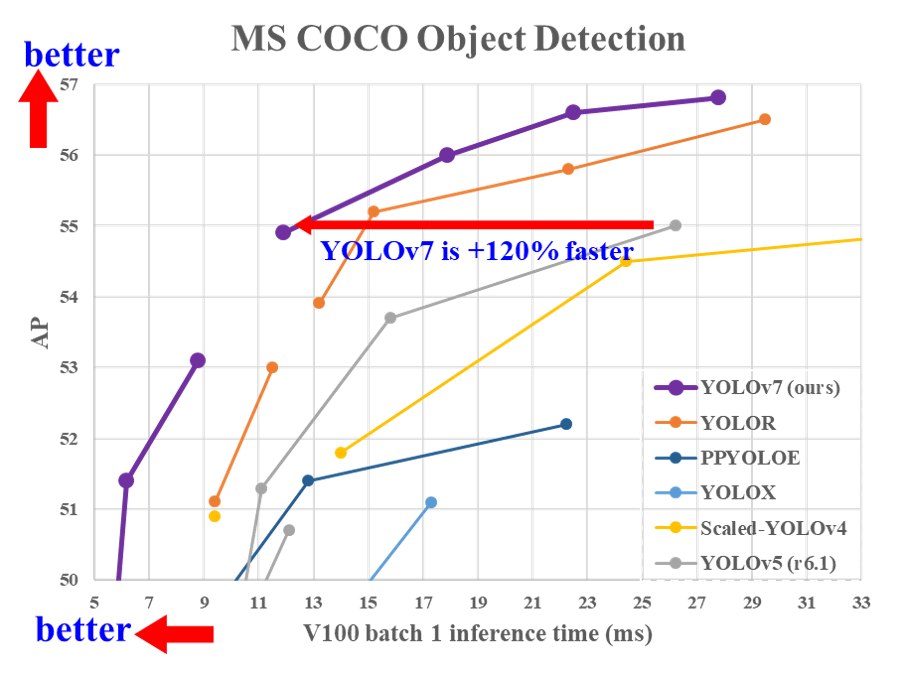
YOLOV7是2022年最新出现的一种YOLO系列目标检测模型,在论文 [YOLOv7: Trainable bag-of-freebies sets new state-of-the-art for real-time object detectors](https://arxiv.org/abs/2207.02696)中提出。
 ## 模型初始化
初始化操作主要利用MIGraphX对输入的模型进行解析,获取模型的输入属性inputAttribute,同时设置使用GPU推理模式对模型进行编译。
```
ErrorCode DetectorYOLOV7::Initialize(InitializationParameterOfDetector initializationParameterOfDetector)
{
...
//模型加载
net = migraphx::parse_onnx(modelPath);
LOG_INFO(stdout,"succeed to load model: %s\n",GetFileName(modelPath).c_str());
// 获取模型输入属性
std::pair inputMap=net.get_parameter_shapes();
inputName=inputAttribute.first;
inputShape=inputAttribute.second;
int N=inputShape.lens()[0];
int C=inputShape.lens()[1];
int H=inputShape.lens()[2];
int W=inputShape.lens()[3];
inputSize=cv::Size(W,H);
// 设置模型为GPU模式
migraphx::target gpuTarget = migraphx::gpu::target{};
// 量化
if(useFP16)
{
migraphx::quantize_fp16(net);
}
// 编译模型
migraphx::compile_options options;
options.device_id=0; // 设置GPU设备,默认为0号设备
options.offload_copy=true; // 设置offload_copy
net.compile(gpuTarget,options);
LOG_INFO(stdout,"succeed to compile model: %s\n",GetFileName(modelPath).c_str());
...
}
```
## 预处理
在将数据输入到模型之前,需要对图像做如下预处理操作:
- 转换数据排布为NCHW
- 归一化到[0.0, 1.0]
- 将输入数据的尺寸变换到YOLOV7输入大小(1,3,640,640)
```c++
ErrorCode DetectorYOLOV7::Detect(const cv::Mat &srcImage, std::vector &resultsOfDetection)
{
...
// 预处理并转换为NCHW
cv::Mat inputBlob;
blobFromImage(srcImage, //输入数据
inputBlob, //输出数据
1 / 255.0, //缩放系数,这里为1/255.0
inputSize, //YOLOV7输入尺寸(640,640)
Scalar(0, 0, 0), // 均值,这里不需要减均值,所以设置为0.0
true, //转换RB通道
false);
...
}
```
## 推理
将预处理之后的图像输入到模型进行推理,获取模型的推理结果inferenceResults,并将输出结果由std::vector< migraphx::argument >类型转换为cv::Mat类型。
```
ErrorCode DetectorYOLOV7::Detect(const cv::Mat &srcImage, std::vector &resultsOfDetection)
{
...
// 创建输入数据
std::unordered_map inputData;
inputData[inputName]= migraphx::argument{inputShape, (float*)inputBlob.data};
// 推理
std::vector inferenceResults=net.eval(inputData);
// 获取推理结果
std::vector outs;
migraphx::argument result = inferenceResults[0];
// 转换为cv::Mat
migraphx::shape outputShape = result.get_shape();
int shape[]={outputShape.lens()[0],outputShape.lens()[1],outputShape.lens()[2]};
cv::Mat out(4,shape,CV_32F);
memcpy(out.data,result.data(),sizeof(float)*outputShape.elements());
outs.push_back(out);
...
}
```
获取MIGraphX推理结果之后需要进一步处理才可以得到YOLOV7的检测结果,输出结果result的第一个维度outputShape.lens()[0]的数值表示YOLOV7模型在当前待检测图像上生成的anchor数量。后处理过程包含两次anchor筛选过程,首先根据阈值objectThreshold判断anchor内部是否包含物体,小于该阈值的anchor则去除,然后获取第一次筛选后保留的anchor内部预测物体类别概率的最高得分,并与boxScores相乘得到anchor的置信度得分,最后根据置信度阈值confidenceThreshold进行第二次anchor筛选,大于该置信度阈值的anchor则保留,并获取最终保留下来anchor的坐标信息和物体类别预测信息,同时还需将预测坐标信息根据图像预处理缩放的比例ratioh、ratiow映射到原图。
```
ErrorCode DetectorYOLOV7::Detect(const cv::Mat &srcImage, std::vector &resultsOfDetection)
{
...
//获取先验框的个数numProposal=25200
int numProposal = outs[0].size[1];
//每个anchor的预测信息数量numOut=85
int numOut = outs[0].size[2];
outs[0] = outs[0].reshape(0, numProposal);
std::vector confidence;
std::vector boxes
std::vector classIds
//原图尺寸与模型输入尺寸的缩放比例
float ratioh = (float)srcImage.rows / inputSize.height, ratiow = (float)srcImage.cols / inputSize.width;
//计算cx,cy,w,h,box_sore,class_sore
int n = 0, rowInd = 0;
float* pdata = (float*)outs[0].data;
for (n = 0; n < numProposal; n++)
{
//获取是否包含物体的概率值
float boxScores = pdata[4];
//第一次筛选,判断anchor内是否包含物体
if (boxScores > yolov7Parameter.objectThreshold)
{
//获取每个anchor内部预测的80个类别概率信息
cv::Mat scores = outs[0].row(rowInd).colRange(5, numOut);
cv::Point classIdPoint;
double maxClassScore;
//获取80个类别中最大概率值和对应的类别ID
cv::minMaxLoc(scores, 0, &maxClassScore, 0, &classIdPoint);
maxClassScore *= boxScores;
//第二次筛选,判断当前anchor的最大置信度得分是否满足阈值
if (maxClassScore > yolov7Parameter.confidenceThreshold)
{
const int classIdx = classIdPoint.x;
//将每个anchor坐标按缩放比例映射到原图
float cx = pdata[0] * ratiow;
float cy = pdata[1] * ratioh;
float w = pdata[2] * ratiow;
float h = pdata[3] * ratioh;
//获取anchor的左上角坐标
int left = int(cx - 0.5 * w);
int top = int(cy - 0.5 * h);
confidences.push_back((float)maxClassScore);
boxes.push_back(cv::Rect(left, top, (int)(w), (int)(h)));
classIds.push_back(classIdx);
}
}
rowInd++;
pdata += numOut;
}
...
}
```
为了消除重叠锚框,输出最终的YOLOV7目标检测结果,执行非极大值抑制对筛选之后的anchor进行处理,最后保存检测结果到resultsOfDetection中。
```
ErrorCode DetectorYOLOV7::Detect(const cv::Mat &srcImage, std::vector &resultsOfDetection)
{
...
//执行non maximum suppression消除冗余重叠boxes
std::vector indices;
dnn::NMSBoxes(boxes, confidences, yolov7Parameter.confidenceThreshold, yolov7Parameter.nmsThreshold, indices);
for (size_t i = 0; i < indices.size(); ++i)
{
int idx = indices[i];
int classID=classIds[idx];
string className=classNames[classID];
float confidence=confidences[idx];
cv::Rect box = boxes[idx];
//保存每个最终预测anchor的坐标值、置信度分数、类别ID
ResultOfDetection result;
result.boundingBox=box;
result.confidence=confidence;// confidence
result.classID=classID; // label
result.className=className;
resultsOfDetection.push_back(result);
}
...
}
```
## 模型初始化
初始化操作主要利用MIGraphX对输入的模型进行解析,获取模型的输入属性inputAttribute,同时设置使用GPU推理模式对模型进行编译。
```
ErrorCode DetectorYOLOV7::Initialize(InitializationParameterOfDetector initializationParameterOfDetector)
{
...
//模型加载
net = migraphx::parse_onnx(modelPath);
LOG_INFO(stdout,"succeed to load model: %s\n",GetFileName(modelPath).c_str());
// 获取模型输入属性
std::pair inputMap=net.get_parameter_shapes();
inputName=inputAttribute.first;
inputShape=inputAttribute.second;
int N=inputShape.lens()[0];
int C=inputShape.lens()[1];
int H=inputShape.lens()[2];
int W=inputShape.lens()[3];
inputSize=cv::Size(W,H);
// 设置模型为GPU模式
migraphx::target gpuTarget = migraphx::gpu::target{};
// 量化
if(useFP16)
{
migraphx::quantize_fp16(net);
}
// 编译模型
migraphx::compile_options options;
options.device_id=0; // 设置GPU设备,默认为0号设备
options.offload_copy=true; // 设置offload_copy
net.compile(gpuTarget,options);
LOG_INFO(stdout,"succeed to compile model: %s\n",GetFileName(modelPath).c_str());
...
}
```
## 预处理
在将数据输入到模型之前,需要对图像做如下预处理操作:
- 转换数据排布为NCHW
- 归一化到[0.0, 1.0]
- 将输入数据的尺寸变换到YOLOV7输入大小(1,3,640,640)
```c++
ErrorCode DetectorYOLOV7::Detect(const cv::Mat &srcImage, std::vector &resultsOfDetection)
{
...
// 预处理并转换为NCHW
cv::Mat inputBlob;
blobFromImage(srcImage, //输入数据
inputBlob, //输出数据
1 / 255.0, //缩放系数,这里为1/255.0
inputSize, //YOLOV7输入尺寸(640,640)
Scalar(0, 0, 0), // 均值,这里不需要减均值,所以设置为0.0
true, //转换RB通道
false);
...
}
```
## 推理
将预处理之后的图像输入到模型进行推理,获取模型的推理结果inferenceResults,并将输出结果由std::vector< migraphx::argument >类型转换为cv::Mat类型。
```
ErrorCode DetectorYOLOV7::Detect(const cv::Mat &srcImage, std::vector &resultsOfDetection)
{
...
// 创建输入数据
std::unordered_map inputData;
inputData[inputName]= migraphx::argument{inputShape, (float*)inputBlob.data};
// 推理
std::vector inferenceResults=net.eval(inputData);
// 获取推理结果
std::vector outs;
migraphx::argument result = inferenceResults[0];
// 转换为cv::Mat
migraphx::shape outputShape = result.get_shape();
int shape[]={outputShape.lens()[0],outputShape.lens()[1],outputShape.lens()[2]};
cv::Mat out(4,shape,CV_32F);
memcpy(out.data,result.data(),sizeof(float)*outputShape.elements());
outs.push_back(out);
...
}
```
获取MIGraphX推理结果之后需要进一步处理才可以得到YOLOV7的检测结果,输出结果result的第一个维度outputShape.lens()[0]的数值表示YOLOV7模型在当前待检测图像上生成的anchor数量。后处理过程包含两次anchor筛选过程,首先根据阈值objectThreshold判断anchor内部是否包含物体,小于该阈值的anchor则去除,然后获取第一次筛选后保留的anchor内部预测物体类别概率的最高得分,并与boxScores相乘得到anchor的置信度得分,最后根据置信度阈值confidenceThreshold进行第二次anchor筛选,大于该置信度阈值的anchor则保留,并获取最终保留下来anchor的坐标信息和物体类别预测信息,同时还需将预测坐标信息根据图像预处理缩放的比例ratioh、ratiow映射到原图。
```
ErrorCode DetectorYOLOV7::Detect(const cv::Mat &srcImage, std::vector &resultsOfDetection)
{
...
//获取先验框的个数numProposal=25200
int numProposal = outs[0].size[1];
//每个anchor的预测信息数量numOut=85
int numOut = outs[0].size[2];
outs[0] = outs[0].reshape(0, numProposal);
std::vector confidence;
std::vector boxes
std::vector classIds
//原图尺寸与模型输入尺寸的缩放比例
float ratioh = (float)srcImage.rows / inputSize.height, ratiow = (float)srcImage.cols / inputSize.width;
//计算cx,cy,w,h,box_sore,class_sore
int n = 0, rowInd = 0;
float* pdata = (float*)outs[0].data;
for (n = 0; n < numProposal; n++)
{
//获取是否包含物体的概率值
float boxScores = pdata[4];
//第一次筛选,判断anchor内是否包含物体
if (boxScores > yolov7Parameter.objectThreshold)
{
//获取每个anchor内部预测的80个类别概率信息
cv::Mat scores = outs[0].row(rowInd).colRange(5, numOut);
cv::Point classIdPoint;
double maxClassScore;
//获取80个类别中最大概率值和对应的类别ID
cv::minMaxLoc(scores, 0, &maxClassScore, 0, &classIdPoint);
maxClassScore *= boxScores;
//第二次筛选,判断当前anchor的最大置信度得分是否满足阈值
if (maxClassScore > yolov7Parameter.confidenceThreshold)
{
const int classIdx = classIdPoint.x;
//将每个anchor坐标按缩放比例映射到原图
float cx = pdata[0] * ratiow;
float cy = pdata[1] * ratioh;
float w = pdata[2] * ratiow;
float h = pdata[3] * ratioh;
//获取anchor的左上角坐标
int left = int(cx - 0.5 * w);
int top = int(cy - 0.5 * h);
confidences.push_back((float)maxClassScore);
boxes.push_back(cv::Rect(left, top, (int)(w), (int)(h)));
classIds.push_back(classIdx);
}
}
rowInd++;
pdata += numOut;
}
...
}
```
为了消除重叠锚框,输出最终的YOLOV7目标检测结果,执行非极大值抑制对筛选之后的anchor进行处理,最后保存检测结果到resultsOfDetection中。
```
ErrorCode DetectorYOLOV7::Detect(const cv::Mat &srcImage, std::vector &resultsOfDetection)
{
...
//执行non maximum suppression消除冗余重叠boxes
std::vector indices;
dnn::NMSBoxes(boxes, confidences, yolov7Parameter.confidenceThreshold, yolov7Parameter.nmsThreshold, indices);
for (size_t i = 0; i < indices.size(); ++i)
{
int idx = indices[i];
int classID=classIds[idx];
string className=classNames[classID];
float confidence=confidences[idx];
cv::Rect box = boxes[idx];
//保存每个最终预测anchor的坐标值、置信度分数、类别ID
ResultOfDetection result;
result.boundingBox=box;
result.confidence=confidence;// confidence
result.classID=classID; // label
result.className=className;
resultsOfDetection.push_back(result);
}
...
}
```