# EdgeTPU-optimized Vision Models
## Image classification task
### Introduction
We are presenting a family of computer vision models based on MobileNetEdgeTPUV2
that are optimized for the next generation Edge TPU ML accelerator in the Google
Tensor SoC that powers the Pixel 6 phones. These models improve the
latency-accuracy pareto-frontier compared to the existing SOTA on-device models
including their predecessor MobileNetEdgeTPUs. MobileNetEdgeTPUV2 can be used as
a standalone image classification model or as a backbone for other computer
vision tasks such as object detection or semantic segmentation.
### Search space design
During the design of MobileNetEdgeTPUV2 we crafted a neural network search space
which includes building blocks that run efficiently on the Edge TPU accelerator
while providing better algorithmic qualities and leveraged AutoML to find the
optimal architectures. As one of the key optimizations, we introduce Group
Convolution based Inverted Bottleneck (IBN) blocks that provide great
flexibility in achieving a tradeoff between latency and accuracy.
Inverted Bottleneck (IBN) is a widely used building block in architecting a
neural network for mobile vision tasks. A conventional IBN uses pointwise
convolutions for expansion/projection before/after a depthwise convolution.
Previously it has been shown that using a full convolution replacing the
pointwise expansion and depthwise convolution can provide more trainable
parameters while being faster. However, one big limitation is that using these
full-convolution IBNs can get very expensive in terms of latency and memory
requirements, especially for narrow/deep tensors that we see in later stages of
vision models. This limits the use of “fused” full-convolution IBNs throughout
the model and leaves depthwise IBN as the only alternative.
Inverted bottleneck block (IBN) variants: (a) Conventional with depthwise, (b) Fused-IBN, (c)GC-IBN with group convolutions in the expansion phase
In this work we utilize Group Convolution (GC) as part of the fused expansion in
constructing IBNs (Figure 1). GC based IBN becomes a versatile block that opens
up a large design space between conventional depthwise IBNs and fused
full-convolution IBNs which can be controlled by the group size parameter.
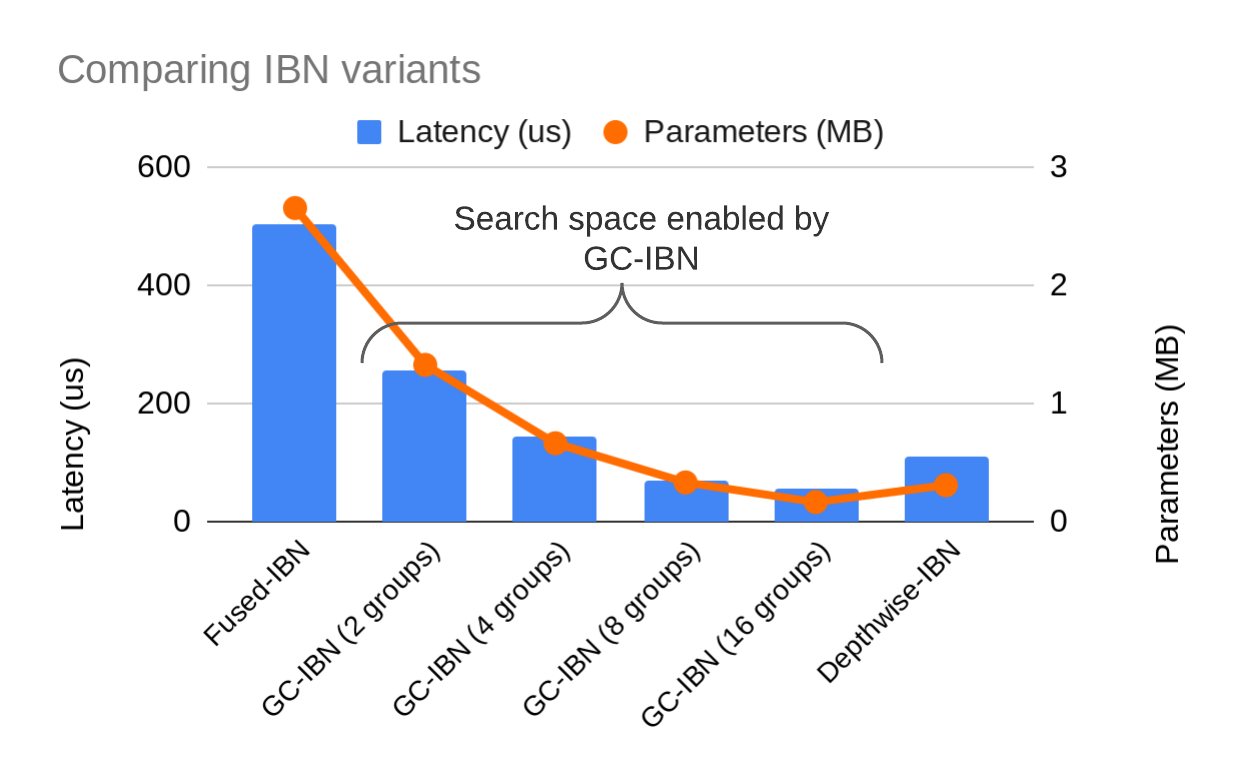
Figure 2 demonstrates the search space enabled by GC-based IBNs that allows a
flexible tradeoff between latency and number of trainable parameters. GC-based
IBNs allow increasing the number of trainable parameters gradually without
requiring the latency cost of full-convolution based IBNs. Moreover, they can
also be faster than conventional IBNs with depthwise convolutions while
providing more trainable parameters.
### Model performance on Edge TPU
Tradeoffs discussed above and exemplified in Figure 2 are highly dependent on
the tensor shapes and cannot be generalized throughout the neural network.
Hence, we use AutoML techniques as a rescue to find the optimal block decisions
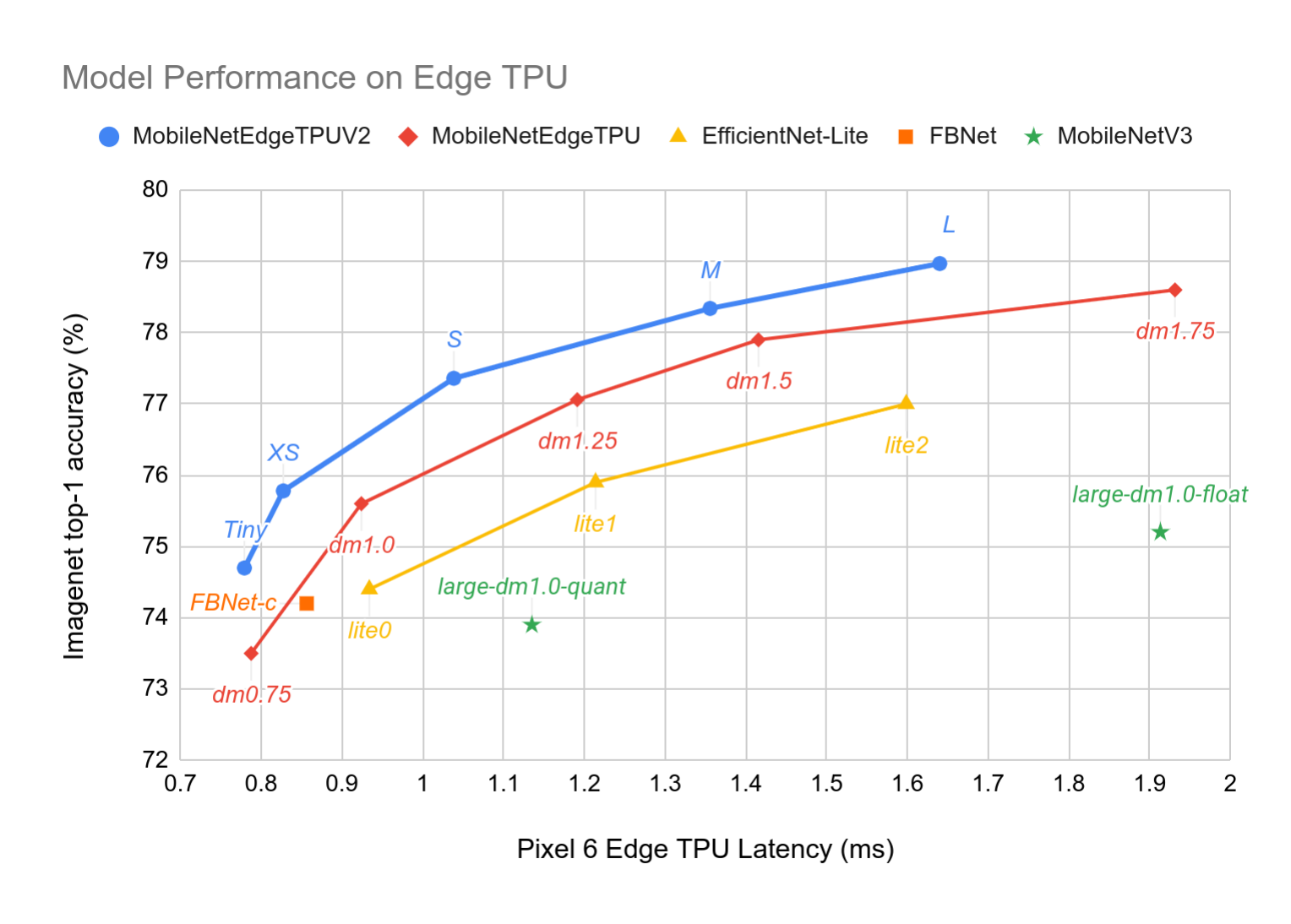
and craft a family of network architectures at different latency targets. Figure
3 demonstrates that the resulting MobileNetEdgeTPUV2 model-family improves the
pareto-frontier compared to the existing on-device SOTA models when run on Edge
TPU.
Comparison of Imagenet top-1 accuracy and Pixel 6 Edge TPU latency of MobileNetEdgeTPUV2 models with other on-device classification models
#### On-device benchmarking of classification models
Results on on-device benchmarking of various int8 quantized image classification
models for 224x224 input resolution:
Model (Checkpoint) | Accuracy (int8) | Pixel 6 Edge TPU Latency (ms) | tflite
----------------------------------------------------------------------------------------------------------------------------------------------------------------------------------- | :-------------: | :---------------------------: | :----:
[MobileNetEdgeTPUv2-Tiny](https://storage.cloud.google.com/tf_model_garden/models/edgetpu/checkpoint_and_tflite/vision/mobilenet-edgetpu-v2/tiny/mobilenet-edgetpu-v2-tiny.tar.gz) | 74.66% | 0.78 | [link](https://storage.cloud.google.com/tf_model_garden/models/edgetpu/checkpoint_and_tflite/vision/mobilenet-edgetpu-v2/tiny/mobilenet_edgetpu_v2_tiny.tflite)
[MobileNetEdgeTPUv2-XS](https://storage.cloud.google.com/tf_model_garden/models/edgetpu/checkpoint_and_tflite/vision/mobilenet-edgetpu-v2/tiny/mobilenet-edgetpu-v2-xs.tar.gz) | 75.79% | 0.82 | [link](https://storage.cloud.google.com/tf_model_garden/models/edgetpu/checkpoint_and_tflite/vision/mobilenet-edgetpu-v2/tiny/mobilenet_edgetpu_v2_xs.tflite)
[MobileNetEdgeTPUv2-S](https://storage.cloud.google.com/tf_model_garden/models/edgetpu/checkpoint_and_tflite/vision/mobilenet-edgetpu-v2/tiny/mobilenet-edgetpu-v2-s.tar.gz) | 77.36% | 1.03 | [link](https://storage.cloud.google.com/tf_model_garden/models/edgetpu/checkpoint_and_tflite/vision/mobilenet-edgetpu-v2/tiny/mobilenet_edgetpu_v2_s.tflite)
[MobileNetEdgeTPUv2-M](https://storage.cloud.google.com/tf_model_garden/models/edgetpu/checkpoint_and_tflite/vision/mobilenet-edgetpu-v2/tiny/mobilenet-edgetpu-v2-m.tar.gz) | 78.43% | 1.35 | [link](https://storage.cloud.google.com/tf_model_garden/models/edgetpu/checkpoint_and_tflite/vision/mobilenet-edgetpu-v2/tiny/mobilenet_edgetpu_v2_m.tflite)
[MobileNetEdgeTPUv2-L](https://storage.cloud.google.com/tf_model_garden/models/edgetpu/checkpoint_and_tflite/vision/mobilenet-edgetpu-v2/tiny/mobilenet-edgetpu-v2-l.tar.gz) | 79.00% | 1.64 | [link](https://storage.cloud.google.com/tf_model_garden/models/edgetpu/checkpoint_and_tflite/vision/mobilenet-edgetpu-v2/tiny/mobilenet_edgetpu_v2_l.tflite)
[MobileNetEdgeTPU dm1.0](https://storage.cloud.google.com/tf_model_garden/models/edgetpu/checkpoint_and_tflite/vision/mobilenet-edgetpu-v1/dm1p0/mobilenet-edgetpu-dm1p0.tar.gz) | 75.6% | 0.92 | [link](https://storage.cloud.google.com/tf_model_garden/models/edgetpu/checkpoint_and_tflite/vision/mobilenet-edgetpu-v1/dm1p0/mobilenet_edgetpu.tflite)
[MobileNetEdgeTPU dm1.25](https://storage.cloud.google.com/tf_model_garden/models/edgetpu/checkpoint_and_tflite/vision/mobilenet-edgetpu-v1/dm1p25/mobilenet-edgetpu-dm1p25.tar.gz) | 77.06% | 1.20 | [link](https://storage.cloud.google.com/tf_model_garden/models/edgetpu/checkpoint_and_tflite/vision/mobilenet-edgetpu-v1/dm1p25/mobilenet_edgetpu_dm1p25.tflite)
[MobileNetEdgeTPU dm1.5](https://storage.cloud.google.com/tf_model_garden/models/edgetpu/checkpoint_and_tflite/vision/mobilenet-edgetpu-v1/dm1p5/mobilenet-edgetpu-dm1p5.tar.gz) | 75.9% | 1.42 | [link](https://storage.cloud.google.com/tf_model_garden/models/edgetpu/checkpoint_and_tflite/vision/mobilenet-edgetpu-v1/dm1p5/mobilenet_edgetpu_dm1p5.tflite)
[MobileNetEdgeTPU dm1.75](https://storage.cloud.google.com/tf_model_garden/models/edgetpu/checkpoint_and_tflite/vision/mobilenet-edgetpu-v1/dm1p75/mobilenet-edgetpu-dm1p75.tar.gz) | 78.6% | 1.93 | [link](https://storage.cloud.google.com/tf_model_garden/models/edgetpu/checkpoint_and_tflite/vision/mobilenet-edgetpu-v1/dm1p75/mobilenet_edgetpu_dm1p75.tflite)
### Model performance on Pixel 6 CPU
Our primary optimization target is the Edge TPU accelerator however in our
search space we include operations that also run well on Pixel 6 CPU to be able
to reach a wide range of platforms. Moreover, we implement GC using functionally
equivalent series of commonly used ML primitives (channelwise slice, full
convolution, concatenation) as shown in Figure 2, since a native GC operation
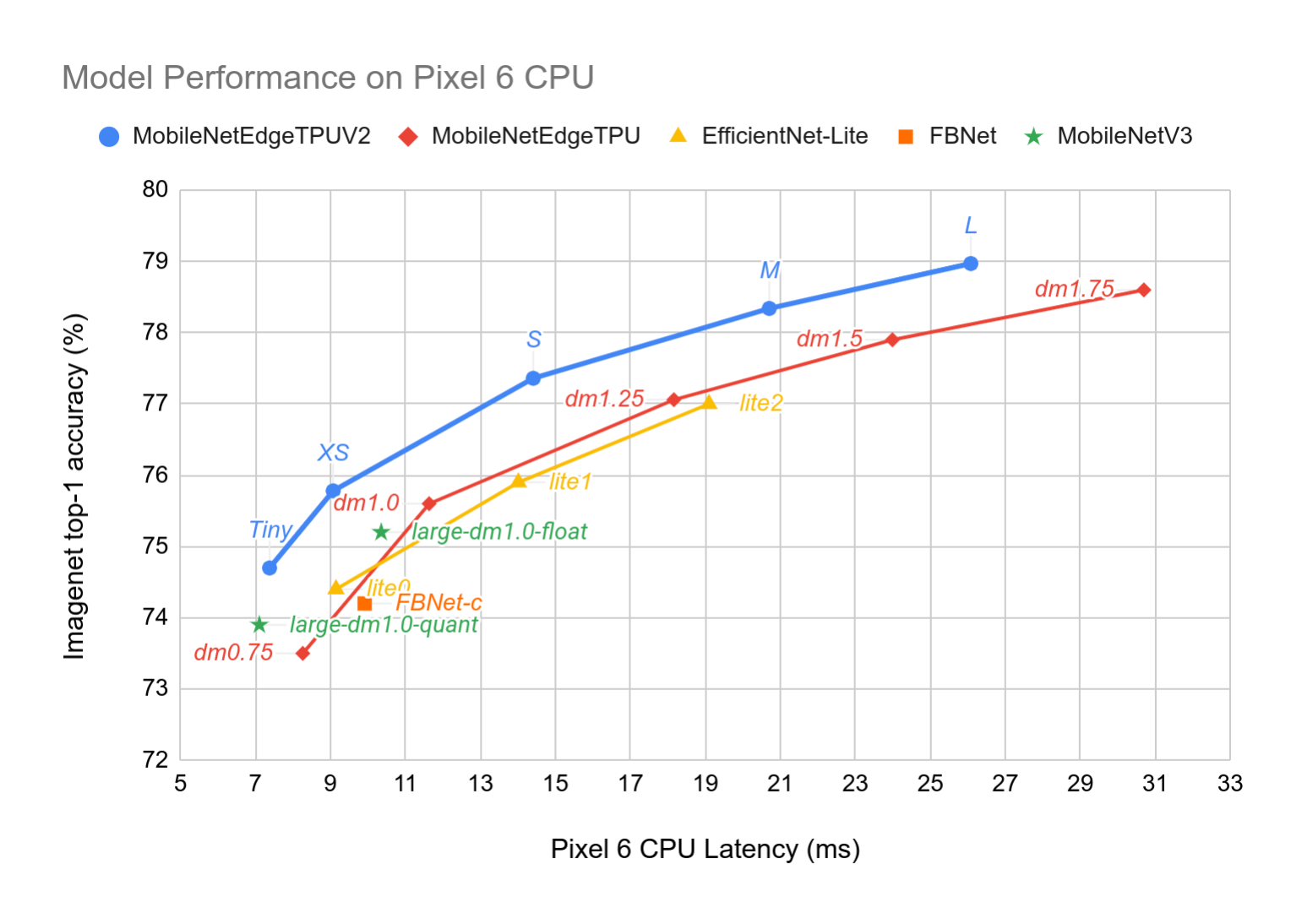
may not be supported for all target platforms. As a result, the performance of
MobileNetEdgeTPUV2 is also superior to other on-device models when run on Pixel
6 CPU as shown in Figure 4.
Comparison of Imagenet top-1 accuracy and Pixel 6 latency of MobileNetEdgeTPUV2 models with other on-device classification models
## Semantic segmentation task
### Using classification models as backbone
We also present segmentation models based on MobileNetEdgeTPUV2 backbone and
DeepLab v3 plus decoder and head (first used
[here](https://arxiv.org/pdf/1802.02611.pdf)). These models optimized for the
next generation Edge TPU accelerators featured in Pixel 6 phones and improve the
latency-accuracy pareto-frontier compared to the their predecessor based on
MobileNetV2 and DeepLabV3+.
The segmentation model is built using the pretrained MobileNetEdgeTPUV2 as a
feature encoder and ASPP decoder in conjunction with a Deeplab V3 Plus head.
Separable convolutions used to reduce the size of the model.
#### Using architecture search to find high-quality, low-latency segmentation models
To further improve the quality of on-device segmentation models, we invoke
architecture search to jointly search for the model's feature extractor and the
segmentation head. Autoseg-EdgeTPU is a set of searched segmentation models
customized for the Edge TPU in Pixel 6. The feature extractor is derived from
Edge TPU search space where a mixture of IBN and fused IBN are used. We
automatically find the optimal kernel size, channel multiplier, expansion ratio,
and groups on a per layer basis using a reinforcement learning algorithm. The
segmentation head is an optimized version of
[Bi-FPN](https://arxiv.org/abs/1911.09070) head, with customized number of
repeats and feature selection.
#### Argmax fusion to improve segmentation model latency
The last two levels of the model (bilinear resizing and Argmax) contribute
significantly to latency on the device model. This is due to the large
activation size between these layers (512 x 512 x Number of classes). These
layers can be merged without significantly impacting quality scores by making
Argmax smaller and scaling the classes to the desired size with nearest
neighbor.
### On-device benchmarking of segmentation models
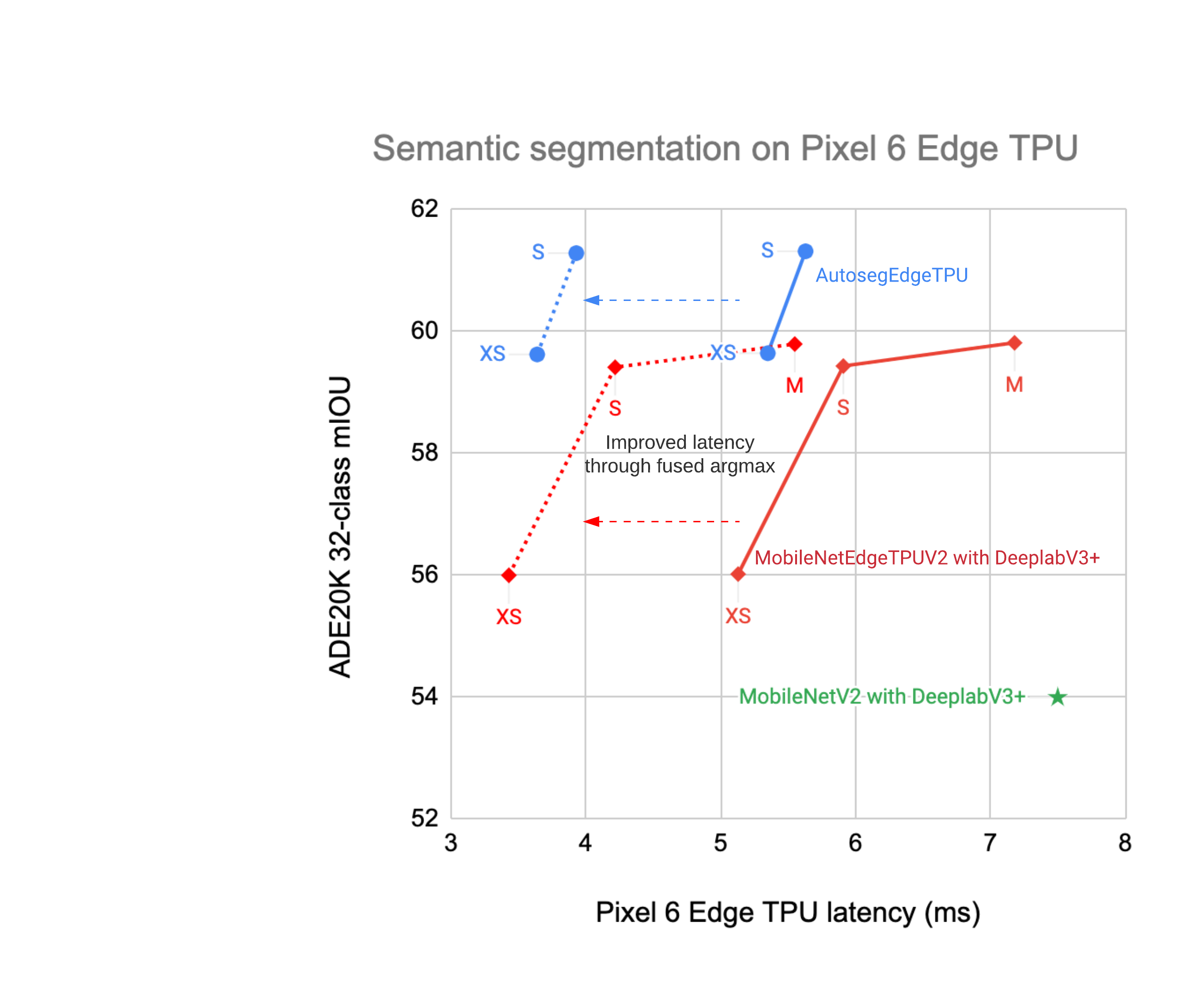
Performance of AutosegEdgeTPU and MobileNetEdgeTPUV2+DeeplabV3+ models on the 32-class ADE20K semantic segmentation task.
Model Name (Checkpoint) | Backbone | Segmentation Head| #Parameters (million)| ADE20K 32-class mIOU| Pixel 6 EdgeTPU latency (ms)| Tflite |
|:---|:-----------------------:|:----------------:|:--------------------:|:-------------------:|:---------------------------:|:------:|
deeplabv3plus_mobilenet_edgetpuv2_baseline| MobileNet V2 (baseline)| DeeplabV3+ | 2.34 | 54.06% | 7.5 | link |
[deeplabv3plus_mobilenet_edgetpuv2_xs](https://storage.cloud.google.com/tf_model_garden/models/edgetpu/checkpoint_and_tflite/vision/segmentation-edgetpu/checkpoints/deeplabv3plus_mobilenet_edgetpuv2_xs_ade20k_32/deeplabv3plus_mobilenet_edgetpuv2_xs_ade20k_32.tar.gz)| MobileNetEdgeTPUV2-XS | DeeplabV3+ | 3.6 | 56.02% | 5.2 | [link](https://storage.cloud.google.com/tf_model_garden/models/edgetpu/checkpoint_and_tflite/vision/segmentation-edgetpu/tflite/default_argmax/deeplabv3plus_mobilenet_edgetpuv2_xs_ade20k_32.tflite) |
[deeplabv3plus_mobilenet_edgetpuv2_s](https://storage.cloud.google.com/tf_model_garden/models/edgetpu/checkpoint_and_tflite/vision/segmentation-edgetpu/checkpoints/deeplabv3plus_mobilenet_edgetpuv2_s_ade20k_32/deeplabv3plus_mobilenet_edgetpuv2_s_ade20k_32.tar.gz)| MobileNetEdgeTPUV2-S | DeeplabV3+ | 5.2 | 59.43% | 5.9 | [link](https://storage.cloud.google.com/tf_model_garden/models/edgetpu/checkpoint_and_tflite/vision/segmentation-edgetpu/tflite/default_argmax/deeplabv3plus_mobilenet_edgetpuv2_s_ade20k_32.tflite) |
[deeplabv3plus_mobilenet_edgetpuv2_m](https://storage.cloud.google.com/tf_model_garden/models/edgetpu/checkpoint_and_tflite/vision/segmentation-edgetpu/checkpoints/deeplabv3plus_mobilenet_edgetpuv2_m_ade20k_32/deeplabv3plus_mobilenet_edgetpuv2_m_ade20k_32.tar.gz)| MobileNetEdgeTPUV2-M | DeeplabV3+ | 7.7 | 59.81% | 7.2 | [link](https://storage.cloud.google.com/tf_model_garden/models/edgetpu/checkpoint_and_tflite/vision/segmentation-edgetpu/tflite/default_argmax/deeplabv3plus_mobilenet_edgetpuv2_m_ade20k_32.tflite) |
[autoseg_edgetpu_xs](https://storage.cloud.google.com/tf_model_garden/models/edgetpu/checkpoint_and_tflite/vision/segmentation-edgetpu/checkpoints/autoseg_edgetpu_xs/autoseg_edgetpu_xs.tar.gz)| AutosegEdgeTPU-XS | BiFPN | 2.9 | 59.64% | 5.4 | [link](https://storage.cloud.google.com/tf_model_garden/models/edgetpu/checkpoint_and_tflite/vision/segmentation-edgetpu/tflite/default_argmax/autoseg_edgetpu_xs.tflite) |
[autoseg_edgetpu_s](https://storage.cloud.google.com/tf_model_garden/models/edgetpu/checkpoint_and_tflite/vision/segmentation-edgetpu/checkpoints/autoseg_edgetpu_s/autoseg_edgetpu_s.tar.gz)| AutosegEdgeTPU-S | BiFPN | 3.1 | 61.31% | 5.7 | [link](https://storage.cloud.google.com/tf_model_garden/models/edgetpu/checkpoint_and_tflite/vision/segmentation-edgetpu/tflite/default_argmax/autoseg_edgetpu_s.tflite) |
By fusing argmax with resize operator as shown above, it is possible to further
improve the on-device latency of the segmentation models without significantly
impacting the quality:
Note: Models with default argmax and fusing argmax are using the same checkpoint
since there is no parameter change.
| Model Name | ADE20K 32-class mIOU| Pixel 6 EdgeTPU latency (ms)| tflite |
|----------------------|:------------------:|:----------------------:|:---------------------:|
| deeplabv3plus_mobilenet_edgetpuv2_xs | 56% | 3.4 | [link](https://storage.cloud.google.com/tf_model_garden/models/edgetpu/checkpoint_and_tflite/vision/segmentation-edgetpu/tflite/fused_argmax/deeplabv3plus_mobilenet_edgetpuv2_xs_ade20k_32.tflite) |
| deeplabv3plus_mobilenet_edgetpuv2_s | 59.41% | 4.2 | [link](https://storage.cloud.google.com/tf_model_garden/models/edgetpu/checkpoint_and_tflite/vision/segmentation-edgetpu/tflite/fused_argmax/deeplabv3plus_mobilenet_edgetpuv2_s_ade20k_32.tflite) |
| deeplabv3plus_mobilenet_edgetpuv2_m | 59.79% | 5.5 | [link](https://storage.cloud.google.com/tf_model_garden/models/edgetpu/checkpoint_and_tflite/vision/segmentation-edgetpu/tflite/fused_argmax/deeplabv3plus_mobilenet_edgetpuv2_m_ade20k_32.tflite) |
| autoseg_edgetpu_xs | 59.62% | 3.6 | [link](https://storage.cloud.google.com/tf_model_garden/models/edgetpu/checkpoint_and_tflite/vision/segmentation-edgetpu/tflite/fused_argmax/autoseg_edgetpu_xs.tflite) |
| autoseg_edgetpu_s | 61.28% | 3.9 | [link](https://storage.cloud.google.com/tf_model_garden/models/edgetpu/checkpoint_and_tflite/vision/segmentation-edgetpu/tflite/fused_argmax/autoseg_edgetpu_s.tflite) |
## Object detection task
EdgeTPU-optimized models for object detection are hosted in the [TensorFlow object
detection API](https://github.com/tensorflow/models/blob/master/research/object_detection/g3doc/tf1_detection_zoo.md#pixel-6-edge-tpu-models)
### Training the models
Note that the `EXPERIMENT_TYPE` has to be in one of the preregistered
classification configs, such as `mobilenet_edgetpu_xs` for classification
models. In case you train segmentation model `EXPERIMENT_TYPE` has to be in one
of the preregistered segmentations configs], such as
`seg_deeplabv3plus_mobilenet_edgetpuv2_s_ade20k`, `autoseg_edgetpu_xs`
```
EXPERIMENT_NAME=xxx # Change this for your run, for example, 'mobilenet-edgetpu-test-run'
EXPERIMENT_TYPE=xxx # Change this for your run, for example, 'mobilenet_edgetpu_v2_xs'
$ python3 train.py \
--experiment_name=${EXPERIMENT_NAME} \
--experiment_type=${EXPERIMENT_TYPE} \
--mode=train_and_eval
```
### From training to quantized inference deployment
To export quantized tflite models using tensorflow post-training quantization:
**For classification models**:
```
$ python3 serving/export_tflite.py
--model_name=${EXPERIMENT_TYPE} \
--ckpt_path=${CHECKPOINT} \
--dataset_dir=/path/to/calibration/dataset \
--output_dir=/tmp \
--quantize \
--image_size=224
```
Note that the `EXPERIMENT_TYPE` has to be in one of the preregistered
classification configs, such as `mobilenet_edgetpu_xs`.
**For segmentation models**:
```
$ python3 serving/export_tflite.py \
--model_name=${EXPERIMENT_TYPE}
--ckpt_path=${CHECKPOINT} \
--dataset_dir=/path/to/calibration/dataset \
--output_dir=/tmp \
--quantize \
--quantize_less_restrictive \
--image_size=512 \
--finalize_method=${ARGMAX_FUSION}
```
`EXPERIMENT_TYPE` has to be in one of the preregistered segmentations configs,
such as `deeplabv3plus_mobilenet_edgetpuv2_s_ade20k_32`.
`ARGMAX_FUSION` has to be in one of the following:
- `resize512,argmax`: Argmax applied after scaling the output to 512x512.
- `resize256,argmax,resize512,squeeze`: Scale the output to 256x256, apply
argmax, scale to 512x512 using nearest neighbor upsampling
- `resize128,argmax,resize512,squeeze`: Scale the output to 128x128, apply
argmax, scale to 512x512 using nearest neighbor upsampling
### On-device benchmarking
The models in this repository are compatible with NNAPI and can be benchmarked
on Pixel 6 devices using the
[tflite benchmark tool](https://www.tensorflow.org/lite/performance/measurement)
While using the benchmark tool, enable the use of NNAPI by setting the
`use_nnapi` command line argument to `true`, and specifying the
`nnapi_accelerator` as `google-edgetpu`
```shell
$ bazel build -c opt --config=android_arm64 tensorflow/lite/tools/benchmark:benchmark_model
# Push binary to device
$ adb push bazel-bin/tensorflow/lite/tools/benchmark/benchmark_model /data/local/tmp
# Push model to device
$ adb push /path/to/model.tflite /data/local/tmp/
# Run on-device benchmarking
$ adb shell /data/local/tmp/benchmark_model --graph=/data/local/tmp/model.tflite --use_nnapi=true --
nnapi_accelerator_name=google-edgetpu
```