# llava
## 论文
Visual Instruction Tuning
[2304.08485 (arxiv.org)](https://arxiv.org/pdf/2304.08485)
## 模型结构
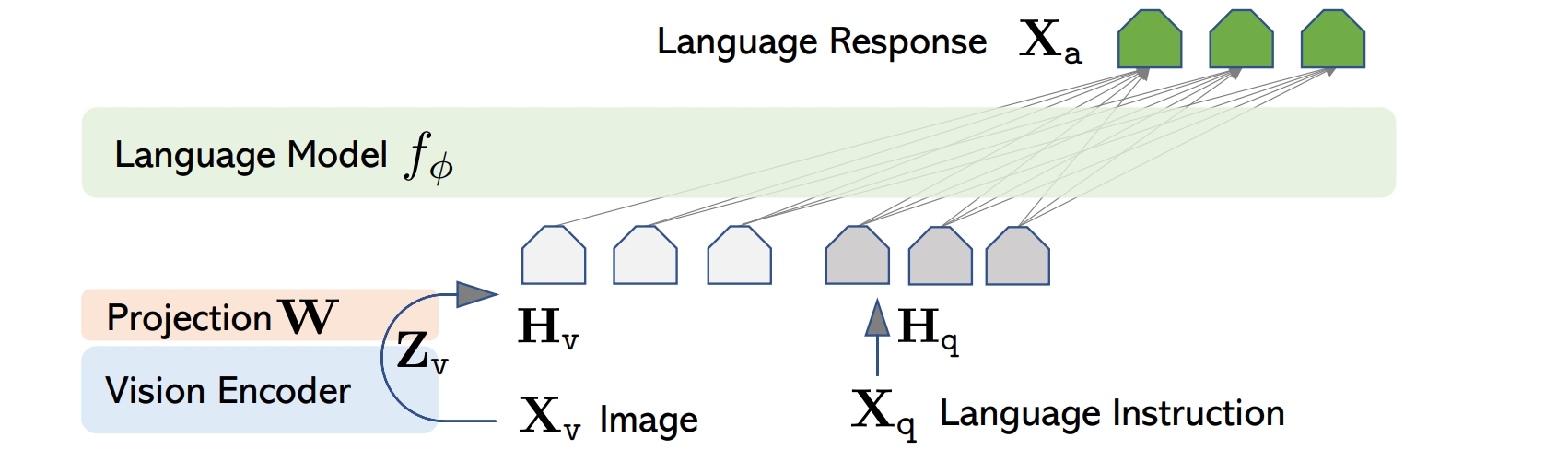
LLaVA(大型语言和视觉助手)是一个开源的大型多模态模型,结合了视觉和语言能力。它通过将视觉编码器与语言模型 Vicuna 结合,实现了先进的视觉和语言理解,在多模态任务中表现优异,并在多个基准测试中(如 Science QA)设立了新的标准。LLaVA 以成本效益高的训练和高效扩展性著称,最近的更新着重提升了多模态推理能力,尤其是对高分辨率图像的理解。
LLaVA 的最新进展包括支持动态高分辨率处理,以及多语言的零样本能力,如中文,展现了在非英语数据上未经特定微调的情况下也能保持出色的表现
## 算法原理
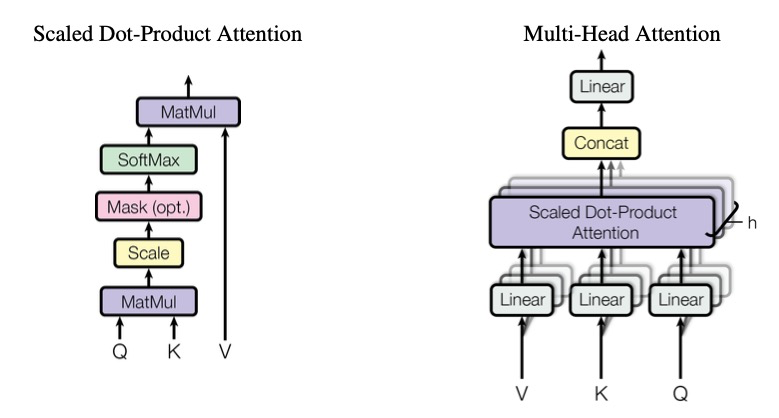
和Qwen一样,Qwen1.5仍然是一个decoder-only的transformer模型,使用SwiGLU激活函数、RoPE、多头注意力机制等。
## 环境配置
### Docker(方法一)
提供[光源](https://www.sourcefind.cn/#/image/dcu/custom)拉取推理的docker镜像:
```
docker pull image.sourcefind.cn:5000/dcu/admin/base/pytorch:2.1.0-ubuntu20.04-dtk24.04.2-py3.10
# 用上面拉取docker镜像的ID替换
# 主机端路径
# 容器映射路径
docker run -it --name qwen1.5_vllm --privileged --shm-size=64G --device=/dev/kfd --device=/dev/dri/ --cap-add=SYS_PTRACE --security-opt seccomp=unconfined --ulimit memlock=-1:-1 --ipc=host --network host --group-add video -v /opt/hyhal:/opt/hyhal -v : /bin/bash
```
`Tips:若在K100/Z100L上使用,使用定制镜像docker pull image.sourcefind.cn:5000/dcu/admin/base/custom:vllm0.5.0-dtk24.04.1-ubuntu20.04-py310-zk-v1,K100/Z100L不支持awq量化`
### Dockerfile(方法二)
```
# 主机端路径
# 容器映射路径
docker build -t qwen1.5:latest .
docker run -it --name qwen1.5_vllm --privileged --shm-size=64G --device=/dev/kfd --device=/dev/dri/ --cap-add=SYS_PTRACE --security-opt seccomp=unconfined --ulimit memlock=-1:-1 --ipc=host --network host --group-add video -v /opt/hyhal:/opt/hyhal:ro -v : qwen1.5:latest /bin/bash
```
### Anaconda(方法三)
```
conda create -n qwen1.5_vllm python=3.10
```
关于本项目DCU显卡所需的特殊深度学习库可从[光合](https://developer.hpccube.com/tool/)开发者社区下载安装。
* DTK驱动:dtk24.04.2
* Pytorch: 2.1.0
* triton:2.1.0
* lmslim: 0.1.0
* xformers: 0.0.25
* flash_attn: 2.0.4
* vllm: 0.5.0
* python: python3.10
`Tips:需先安装相关依赖,最后安装vllm包`
## 数据集
无
## 推理
### 模型下载
| 基座模型 | chat模型 | GPTQ模型 | AWQ模型 |
| -------------------------------------------------------------- | --------------------------------------------------------------------------- | ------------------------------------------------------------------------------------------ | -------------------------------------------------------------------------------------------- |
| [Qwen-7B](https://huggingface.co/Qwen/Qwen-7B) | [Qwen-7B-Chat](http://113.200.138.88:18080/aimodels/Qwen-7B-Chat) | [Qwen-7B-Chat-GPTQ-Int4](https://huggingface.co/Qwen/Qwen-7B-Chat-Int4) | |
| [Qwen-14B](https://huggingface.co/Qwen/Qwen-14B) | [Qwen-14B-Chat](http://113.200.138.88:18080/aimodels/Qwen-14B-Chat) | [Qwen-14B-Chat-GPTQ-Int4](https://huggingface.co/Qwen/Qwen-14B-Chat-Int4) | |
| [Qwen-72B](http://113.200.138.88:18080/aimodels/qwen/Qwen-72B) | [Qwen-72B-Chat](http://113.200.138.88:18080/aimodels/Qwen-72B-Chat) | [Qwen-72B-Chat-GPTQ-Int4](https://huggingface.co/Qwen/Qwen-72B-Chat-Int4) | |
| [Qwen1.5-7B](https://huggingface.co/Qwen/Qwen1.5-7B) | [Qwen1.5-7B-Chat](https://huggingface.co/Qwen/Qwen1.5-7B-Chat) | [Qwen1.5-7B-Chat-GPTQ-Int4](https://huggingface.co/Qwen/Qwen1.5-7B-Chat-GPTQ-Int4) | [Qwen1.5-7B-Chat-AWQ-Int4](http://113.200.138.88:18080/aimodels/qwen/Qwen1.5-7B-Chat-AWQ) |
| [Qwen1.5-14B](https://huggingface.co/Qwen/Qwen1.5-14B) | [Qwen1.5-14B-Chat](http://113.200.138.88:18080/aimodels/qwen/Qwen1.5-14B-Chat) | [Qwen1.5-14B-Chat-GPTQ-Int4](https://huggingface.co/Qwen/Qwen1.5-14B-Chat-GPTQ-Int4) | [Qwen1.5-14B-Chat-AWQ-Int4](http://113.200.138.88:18080/aimodels/qwen/Qwen1.5-14B-Chat-AWQ) |
| [Qwen1.5-32B](http://113.200.138.88:18080/aimodels/Qwen1.5-32B) | [Qwen1.5-32B-Chat](http://113.200.138.88:18080/aimodels/Qwen1.5-32B-Chat) | [Qwen1.5-32B-Chat-GPTQ-Int4](http://113.200.138.88:18080/aimodels/Qwen1.5-32B-Chat-GPTQ-Int4) | [Qwen1.5-32B-Chat-AWQ-Int4](https://huggingface.co/Qwen/Qwen1.5-32B-Chat-AWQ) |
| [Qwen1.5-72B](http://113.200.138.88:18080/aimodels/Qwen1.5-72B) | [Qwen1.5-72B-Chat](http://113.200.138.88:18080/aimodels/Qwen1.5-72B-Chat) | [Qwen1.5-72B-Chat-GPTQ-Int4](https://huggingface.co/Qwen/Qwen1.5-72B-Chat-GPTQ-Int4) | [Qwen1.5-72B-Chat-AWQ-Int4](http://113.200.138.88:18080/aimodels/qwen/Qwen1.5-72B-Chat-AWQ) |
| [Qwen1.5-110B](http://113.200.138.88:18080/aimodels/Qwen1.5-110B) | [Qwen1.5-110B-Chat](http://113.200.138.88:18080/aimodels/Qwen1.5-110B-Chat) | [Qwen1.5-110B-Chat-GPTQ-Int4](https://huggingface.co/Qwen/Qwen1.5-110B-Chat-GPTQ-Int4) | [Qwen1.5-110B-Chat-AWQ-Int4](http://113.200.138.88:18080/aimodels/qwen/Qwen1.5-110B-Chat-AWQ) |
| [Qwen2-7B](http://113.200.138.88:18080/aimodels/Qwen2-7B) | [Qwen2-7B-Instruct](http://113.200.138.88:18080/aimodels/Qwen2-7B-Instruct) | [Qwen2-7B-Instruct-GPTQ-Int4](https://huggingface.co/Qwen/Qwen2-7B-Instruct-GPTQ-Int4) | [Qwen2-7B-Instruct-AWQ-Int4](http://113.200.138.88:18080/aimodels/qwen/Qwen2-7B-Instruct-AWQ) |
| [Qwen2-72B](http://113.200.138.88:18080/aimodels/Qwen2-72B) | [Qwen2-72B-Instruct](http://113.200.138.88:18080/aimodels/Qwen2-72B-Instruct) | [Qwen2-72B-Instruct-GPTQ-Int4](https://huggingface.co/Qwen/Qwen2-72B-Instruct-GPTQ-Int4) | [Qwen2-72B-Instruct-AWQ-Int4](http://113.200.138.88:18080/aimodels/qwen/Qwen2-72B-Instruct-AWQ) |
### 离线批量推理
```bash
python examples/offline_inference.py
```
其中,`prompts`为提示词;`temperature`为控制采样随机性的值,值越小模型生成越确定,值变高模型生成更随机,0表示贪婪采样,默认为1;`max_tokens=16`为生成长度,默认为1;
`model`为模型路径;`tensor_parallel_size=1`为使用卡数,默认为1;`dtype="float16"`为推理数据类型,如果模型权重是bfloat16,需要修改为float16推理,`quantization="gptq"`为使用gptq量化进行推理,需下载以上GPTQ模型。`quantization="awq"`为使用awq量化进行推理,需下载以上AWQ模型。
### 离线批量推理性能测试
1、指定输入输出
```bash
python benchmarks/benchmark_throughput.py --num-prompts 1 --input-len 32 --output-len 128 --model Qwen/Qwen1.5-7B-Chat -tp 1 --trust-remote-code --enforce-eager --dtype float16
```
其中 `--num-prompts`是batch数,`--input-len`是输入seqlen,`--output-len`是输出token长度,`--model`为模型路径,`-tp`为使用卡数,`dtype="float16"`为推理数据类型,如果模型权重是bfloat16,需要修改为float16推理。若指定 `--output-len 1`即为首字延迟。`-q gptq`为使用gptq量化模型进行推理。
2、使用数据集
下载数据集:
```bash
wget https://huggingface.co/datasets/anon8231489123/ShareGPT_Vicuna_unfiltered/resolve/main/ShareGPT_V3_unfiltered_cleaned_split.json
```
```bash
python benchmarks/benchmark_throughput.py --num-prompts 1 --model Qwen/Qwen1.5-7B-Chat --dataset ShareGPT_V3_unfiltered_cleaned_split.json -tp 1 --trust-remote-code --enforce-eager --dtype float16
```
其中 `--num-prompts`是batch数,`--model`为模型路径,`--dataset`为使用的数据集,`-tp`为使用卡数,`dtype="float16"`为推理数据类型,如果模型权重是bfloat16,需要修改为float16推理。`-q gptq`为使用gptq量化模型进行推理。
### api服务推理性能测试
1、启动服务端:
```bash
python -m vllm.entrypoints.openai.api_server --model Qwen/Qwen1.5-7B-Chat --dtype float16 --enforce-eager -tp 1
```
2、启动客户端:
```bash
python benchmarks/benchmark_serving.py --model Qwen/Qwen1.5-7B-Chat --dataset ShareGPT_V3_unfiltered_cleaned_split.json --num-prompts 1 --trust-remote-code
```
参数同使用数据集,离线批量推理性能测试,具体参考[benchmarks/benchmark_serving.py](benchmarks/benchmark_serving.py)
### OpenAI兼容服务
启动服务:
```bash
python -m vllm.entrypoints.openai.api_server --model Qwen/Qwen1.5-7B-Chat --enforce-eager --dtype float16 --trust-remote-code
```
这里 `--model`为加载模型路径,`--dtype`为数据类型:float16,默认情况使用tokenizer中的预定义聊天模板,`--chat-template`可以添加新模板覆盖默认模板,`-q gptq`为使用gptq量化模型进行推理,`-q awqq`为使用awq量化模型进行推理。
列出模型型号:
```bash
curl http://localhost:8000/v1/models
```
### OpenAI Completions API和vllm结合使用
```bash
curl http://localhost:8000/v1/completions \
-H "Content-Type: application/json" \
-d '{
"model": "Qwen/Qwen1.5-7B",
"prompt": "What is deep learning?",
"max_tokens": 7,
"temperature": 0
}'
```
或者使用[examples/openai_completion_client.py](examples/openai_completion_client.py)
### OpenAI Chat API和vllm结合使用
```bash
curl http://localhost:8000/v1/chat/completions \
-H "Content-Type: application/json" \
-d '{
"model": "Qwen/Qwen1.5-7B-Chat",
"messages": [
{"role": "system", "content": "What is deep learning?"},
{"role": "user", "content": "What is deep learning?"}
]
}'
```
或者使用[examples/openai_chatcompletion_client.py](examples/openai_chatcompletion_client.py)
## result
使用的加速卡:1张 DCU-K100_AI-64G
```
Prompt: 'What is deep learning?', Generated text: ' Deep learning is a subset of machine learning that involves the use of neural networks to model and solve complex problems. Neural networks are a network of interconnected nodes or " neurons" that are designed to recognize patterns in data, learn from examples, and make predictions or decisions.\nThe term "deep" in deep learning refers to the use of multiple layers or hidden layers in these neural networks. Each layer processes the input data in a different way, extracting increasingly abstract features as the data passes through.'
```
### 精度
无
## 应用场景
### 算法类别
对话问答
### 热点应用行业
金融,科研,教育
## 源码仓库及问题反馈
* [https://developer.hpccube.com/codes/modelzoo/qwen1.5_vllm](https://developer.hpccube.com/codes/modelzoo/qwen1.5_vllm)
## 参考资料
* [https://github.com/vllm-project/vllm](https://github.com/vllm-project/vllm)