# Sharing
The Hugging Face [Hub](https://hf.co/models) is a platform for sharing, discovering, and consuming models of all different types and sizes. We highly recommend sharing your model on the Hub to push open-source machine learning forward for everyone!
This guide will show you how to share a model to the Hub from Transformers.
## Set up
To share a model to the Hub, you need a Hugging Face [account](https://hf.co/join). Create a [User Access Token](https://hf.co/docs/hub/security-tokens#user-access-tokens) (stored in the [cache](./installation#cache-directory) by default) and login to your account from either the command line or notebook.
```bash
hf auth login
```
```py
from huggingface_hub import notebook_login
notebook_login()
```
## Repository features
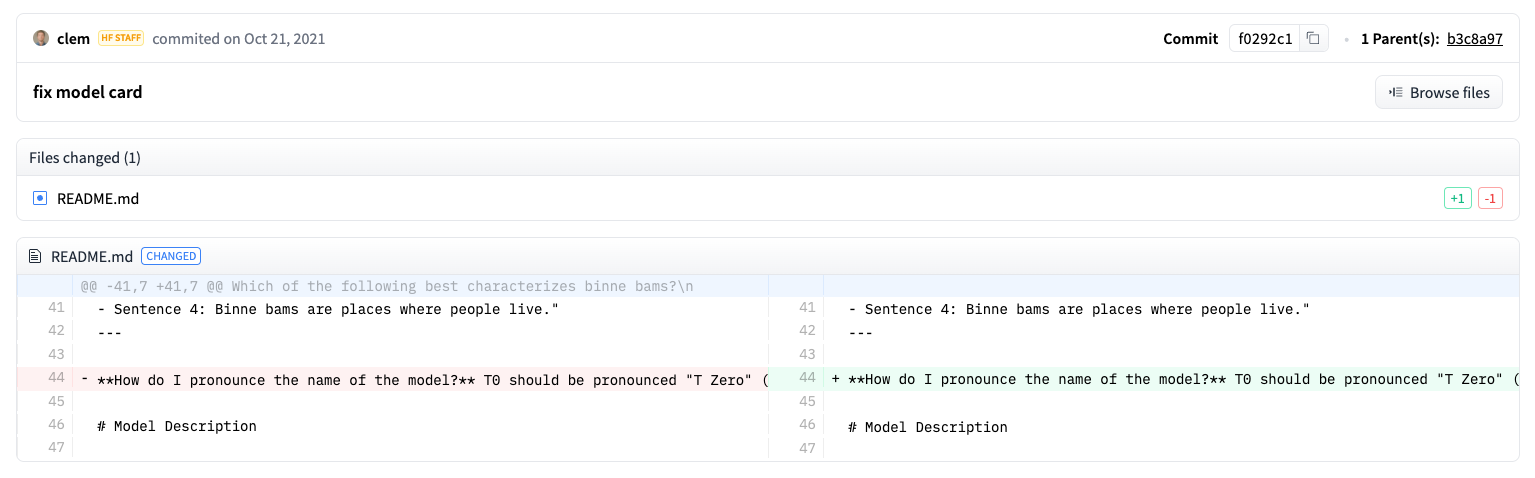
Each model repository features versioning, commit history, and diff visualization.
Versioning is based on [Git](https://git-scm.com/) and [Git Large File Storage (LFS)](https://git-lfs.github.com/), and it enables revisions, a way to specify a model version with a commit hash, tag or branch.
For example, use the `revision` parameter in [`~PreTrainedModel.from_pretrained`] to load a specific model version from a commit hash.
```py
model = AutoModel.from_pretrained(
"julien-c/EsperBERTo-small", revision="4c77982"
)
```
Model repositories also support [gating](https://hf.co/docs/hub/models-gated) to control who can access a model. Gating is common for allowing a select group of users to preview a research model before it's made public.
A model repository also includes an inference [widget](https://hf.co/docs/hub/models-widgets) for users to directly interact with a model on the Hub.
Check out the Hub [Models](https://hf.co/docs/hub/models) documentation to for more information.
## Uploading a model
There are several ways to upload a model to the Hub depending on your workflow preference. You can push a model with [`Trainer`], call [`~PreTrainedModel.push_to_hub`] directly on a model, or use the Hub web interface.
### Trainer
[`Trainer`] can push a model directly to the Hub after training. Set `push_to_hub=True` in [`TrainingArguments`] and pass it to [`Trainer`]. Once training is complete, call [`~transformers.Trainer.push_to_hub`] to upload the model.
[`~transformers.Trainer.push_to_hub`] automatically adds useful information like training hyperparameters and results to the model card.
```py
from transformers import TrainingArguments, Trainer
training_args = TrainingArguments(output_dir="my-awesome-model", push_to_hub=True)
trainer = Trainer(
model=model,
args=training_args,
train_dataset=small_train_dataset,
eval_dataset=small_eval_dataset,
compute_metrics=compute_metrics,
)
trainer.push_to_hub()
```
### PushToHubMixin
The [`~utils.PushToHubMixin`] provides functionality for pushing a model or tokenizer to the Hub.
Call [`~utils.PushToHubMixin.push_to_hub`] directly on a model to upload it to the Hub. It creates a repository under your namespace with the model name specified in [`~utils.PushToHubMixin.push_to_hub`].
```py
model.push_to_hub("my-awesome-model")
```
Other objects like a tokenizer are also pushed to the Hub in the same way.
```py
tokenizer.push_to_hub("my-awesome-model")
```
Your Hugging Face profile should now display the newly created model repository. Navigate to the **Files** tab to see all the uploaded files.
Refer to the [Upload files to the Hub](https://hf.co/docs/hub/how-to-upstream) guide for more information about pushing files to the Hub.
### Hub web interface
The Hub web interface is a no-code approach for uploading a model.
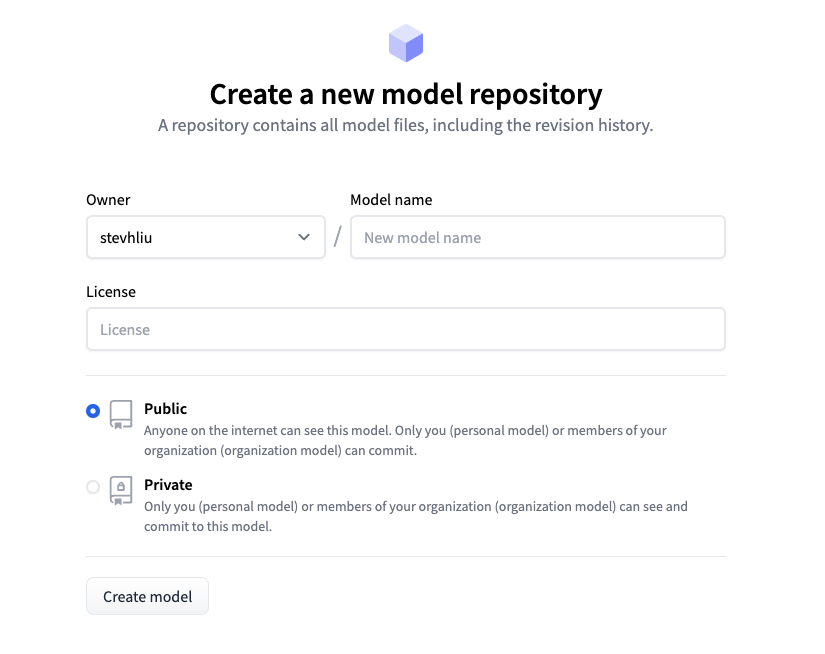
1. Create a new repository by selecting [**New Model**](https://huggingface.co/new).
Add some information about your model:
- Select the **owner** of the repository. This can be yourself or any of the organizations you belong to.
- Pick a name for your model, which will also be the repository name.
- Choose whether your model is public or private.
- Set the license usage.
2. Click on **Create model** to create the model repository.
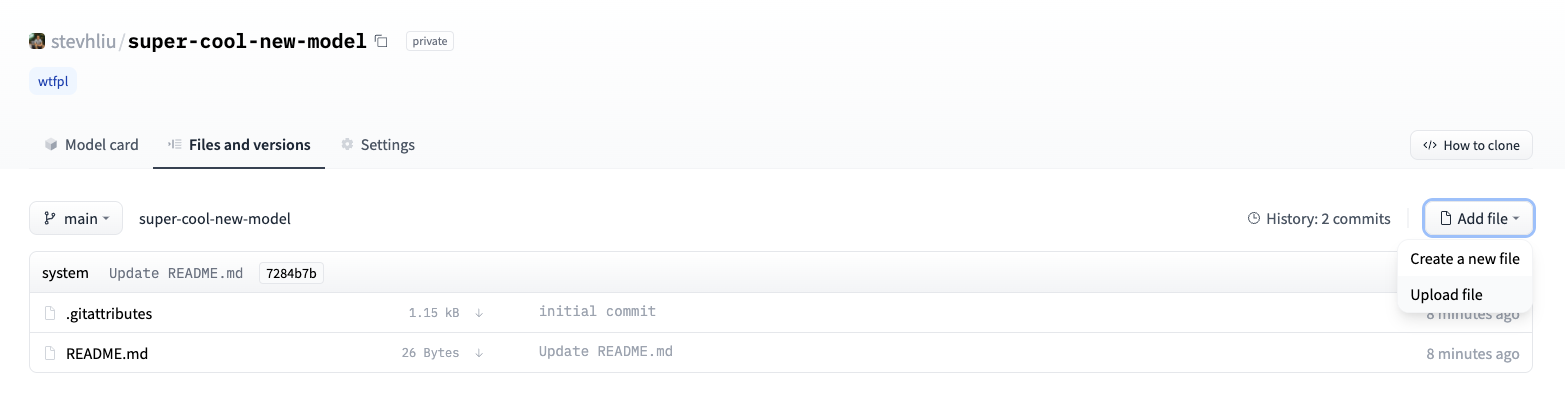
3. Select the **Files** tab and click on the **Add file** button to drag-and-drop a file to your repository. Add a commit message and click on **Commit changes to main** to commit the file.
## Model card
[Model cards](https://hf.co/docs/hub/model-cards#model-cards) inform users about a models performance, limitations, potential biases, and ethical considerations. It is highly recommended to add a model card to your repository!
A model card is a `README.md` file in your repository. Add this file by:
- manually creating and uploading a `README.md` file
- clicking on the **Edit model card** button in the repository
Take a look at the Llama 3.1 [model card](https://huggingface.co/meta-llama/Meta-Llama-3.1-8B-Instruct) for an example of what to include on a model card.
Learn more about other model card metadata (carbon emissions, license, link to paper, etc.) available in the [Model Cards](https://hf.co/docs/hub/model-cards#model-cards) guide.