# Tile Language
Tile Language (**tile-lang**) is a concise domain-specific language designed to streamline the development of high-performance GPU/CPU kernels (e.g., GEMM, Dequant GEMM, FlashAttention, LinearAttention). By employing a Pythonic syntax with an underlying compiler infrastructure on top of [TVM](https://tvm.apache.org/), tile-lang allows developers to focus on productivity without sacrificing the low-level optimizations necessary for state-of-the-art performance.
 ## Latest News
- 01/20/2025 ✨: We are excited to announce that tile-lang, a dsl for high performance AI workloads, is now open source and available to the public!
## Tested Devices
Although tile-lang aims to be portable across a range of Devices, it has been specifically tested and validated on the following devices: for NVIDIA GPUs, this includes the H100 (with Auto TMA/WGMMA support), A100, V100, RTX 4090, RTX 3090, and RTX A600; for AMD GPUs, it includes the MI250 (with Auto MatrixCore support) and the MI300X (with Async Copy support).
## OP Implementation Examples
**tile-lang** provides the building blocks to implement a wide variety of operators. Some examples include:
- [Matrix Multiplication](./examples/gemm/)
- [Dequantization GEMM](./examples/dequantize_gemm/)
- [Flash Attention](./examples/flash_attention/)
- [Flash Linear Attention](./examples/linear_attention/)
Within the `examples` repository, you will also find additional complex kernels—such as convolutions, forward/backward passes for FlashAttention.
## Benchmark Summary
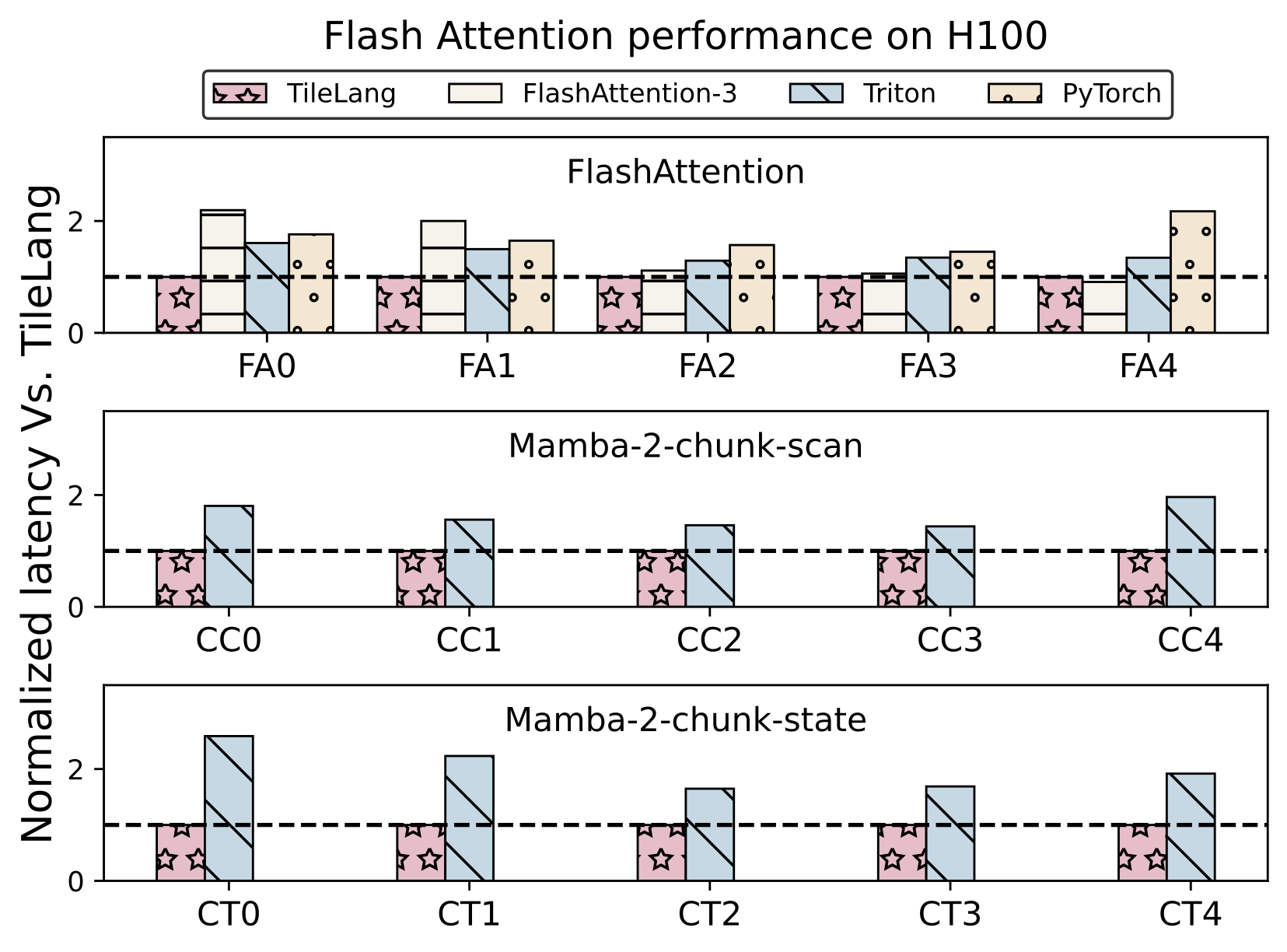
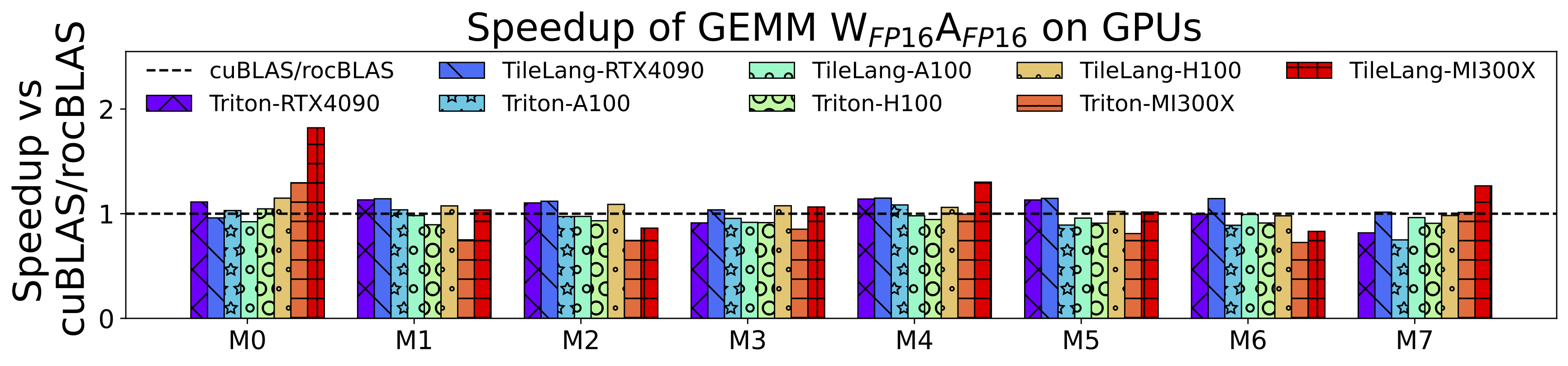
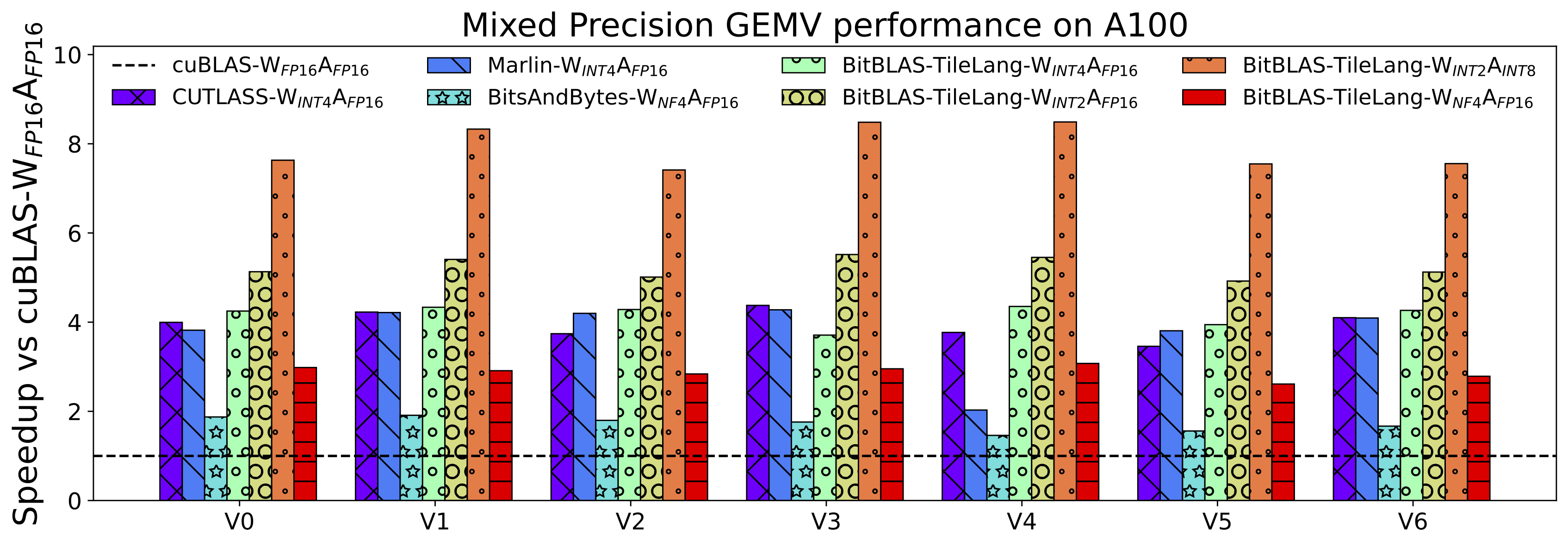
TileLang achieves exceptional performance across a variety of computational patterns. Below are selected results showcasing its capabilities:
- Flash Attention Performance on H100
- Matmul Performance on GPUs (RTX 4090, A100, H100, MI300X)
- Dequantize Matmul Performance on A100
## Installation
### Method 1: Install with Pip
The quickest way to get started is to install the latest release from PyPI:
```bash
pip install tilelang
```
Alternatively, you can install directly from the GitHub repository:
```bash
pip install git+https://github.com/TileLang/tile-lang
```
Or install locally:
```bash
pip install . # with -e option if you want to install in editable mode
```
### Method 2: Build from Source
We currently provide three ways to install **tile-lang** from source:
- [Install from Source (using your own TVM installation)](./docs/Installation.md#install-from-source-with-your-own-tvm-installation)
- [Install from Source (using the bundled TVM submodule)](./docs/Installation.md#install-from-source-with-our-tvm-submodule)
- [Install Using the Provided Script](./docs/Installation.md#install-with-provided-script)
## Quick Start
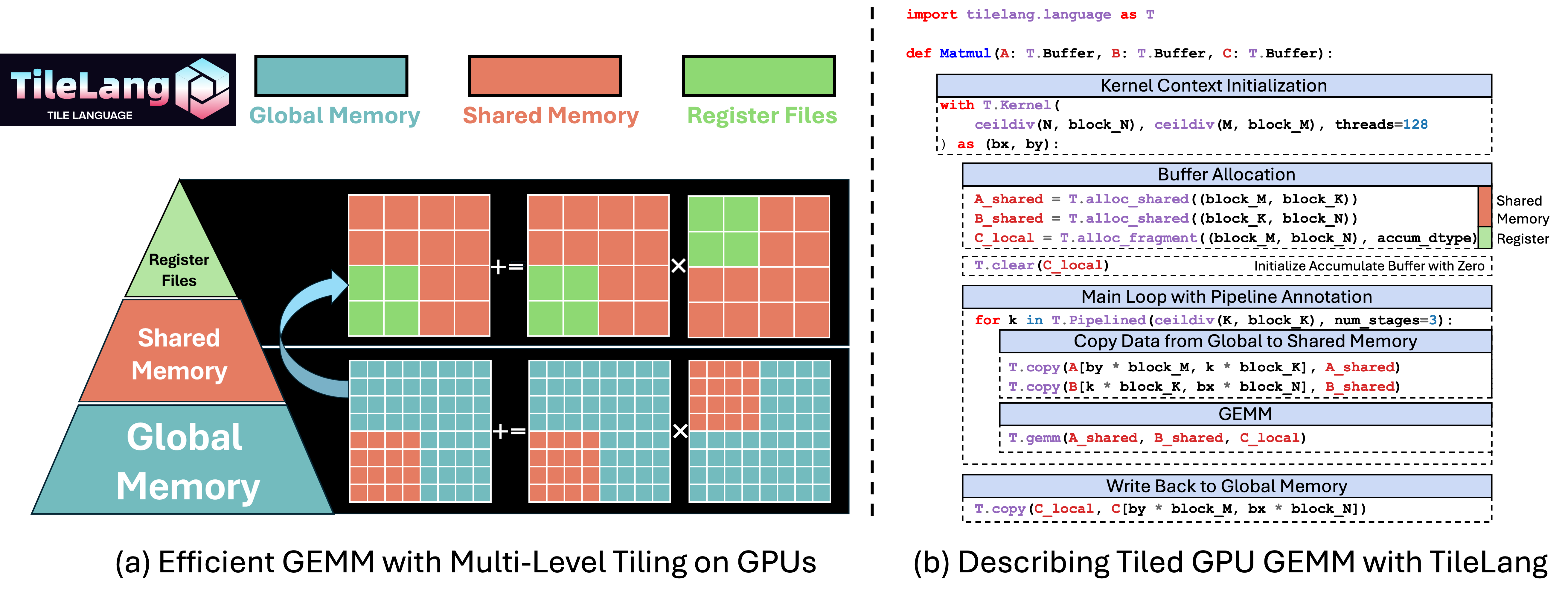
In this section, you’ll learn how to write and execute a straightforward GEMM (matrix multiplication) kernel using tile-lang, followed by techniques for layout optimizations, pipelining, and L2-cache–friendly swizzling.
### GEMM Example with Annotations (Layout, L2 Cache Swizzling, and Pipelining, etc.)
Below is an example that demonstrates more advanced features: layout annotation, parallelized copy, and swizzle for improved L2 cache locality. This snippet shows how to adapt your kernel to maximize performance on complex hardware.
```python
import tilelang.language as T
# `make_mma_swizzle_layout` is a python defined layout function
# specifically designed for for MMA operations
# which ensures the consistency with the nvidia CUTLASS Library.
# to avoid bank conflicts and maximize the performance.
from tilelang.intrinsics import (
make_mma_swizzle_layout as make_swizzle_layout,)
def matmul(M, N, K, block_M, block_N, block_K, dtype="float16", accum_dtype="float"):
@T.prim_func
def main(
A: T.Buffer((M, K), dtype),
B: T.Buffer((K, N), dtype),
C: T.Buffer((M, N), dtype),
):
# Kernel configuration remains similar
with T.Kernel(T.ceildiv(N, block_N), T.ceildiv(M, block_M), threads=128) as (bx, by):
A_shared = T.alloc_shared((block_M, block_K), dtype)
B_shared = T.alloc_shared((block_K, block_N), dtype)
C_local = T.alloc_fragment((block_M, block_N), accum_dtype)
# Apply layout optimizations or define your own layout (Optional)
# If not specified, we will deduce the layout automatically
T.annotate_layout({
A_shared: make_swizzle_layout(A_shared),
B_shared: make_swizzle_layout(B_shared),
})
# Enable rasterization for better L2 cache locality (Optional)
T.use_swizzle(panel_size=10, enable=True)
# Clear local accumulation
T.clear(C_local)
for k in T.Pipelined(T.ceildiv(K, block_K), num_stages=3):
# Copy tile of A
# This is a sugar syntax for parallelized copy
T.copy(A[by * block_M, k * block_K], A_shared)
# Demonstrate parallelized copy from global to shared for B
for ko, j in T.Parallel(block_K, block_N):
B_shared[ko, j] = B[k * block_K + ko, bx * block_N + j]
# Perform a tile-level GEMM on the shared buffers
# Currently we dispatch to the cute/hip on Nvidia/AMD GPUs
T.gemm(A_shared, B_shared, C_local)
# Copy result back to global memory
T.copy(C_local, C[by * block_M, bx * block_N])
return main
```
### Dive Deep into TileLang Beyond GEMM
In addition to GEMM, we provide a variety of examples to showcase the versatility and power of TileLang, including:
- [Dequantize GEMM](./examples/dequantize_gemm/): Achieve high-performance dequantization by **fine-grained control over per-thread operations**, with many features now adopted as default behaviors in [BitBLAS](https://github.com/microsoft/BitBLAS), which utilizing magic layout transformation and intrins to accelerate dequantize gemm.
- [FlashAttention](./examples/flash_attention/): Enable cross-operator fusion with simple and intuitive syntax, and we also provide an example of auto tuning.
- [LinearAttention](./examples/linear_attention/): Examples include RetNet and Mamba implementations.
- [Convolution](./examples/convolution/): Implementations of Convolution with IM2Col.
More operators will continuously be added.
---
TileLang has now been used in project [BitBLAS](https://github.com/microsoft/BitBLAS).
## Acknowledgements
We learned a lot from the [TVM](https://github.com/apache/tvm) community and would like to thank them for their contributions.
## Latest News
- 01/20/2025 ✨: We are excited to announce that tile-lang, a dsl for high performance AI workloads, is now open source and available to the public!
## Tested Devices
Although tile-lang aims to be portable across a range of Devices, it has been specifically tested and validated on the following devices: for NVIDIA GPUs, this includes the H100 (with Auto TMA/WGMMA support), A100, V100, RTX 4090, RTX 3090, and RTX A600; for AMD GPUs, it includes the MI250 (with Auto MatrixCore support) and the MI300X (with Async Copy support).
## OP Implementation Examples
**tile-lang** provides the building blocks to implement a wide variety of operators. Some examples include:
- [Matrix Multiplication](./examples/gemm/)
- [Dequantization GEMM](./examples/dequantize_gemm/)
- [Flash Attention](./examples/flash_attention/)
- [Flash Linear Attention](./examples/linear_attention/)
Within the `examples` repository, you will also find additional complex kernels—such as convolutions, forward/backward passes for FlashAttention.
## Benchmark Summary
TileLang achieves exceptional performance across a variety of computational patterns. Below are selected results showcasing its capabilities:
- Flash Attention Performance on H100
- Matmul Performance on GPUs (RTX 4090, A100, H100, MI300X)
- Dequantize Matmul Performance on A100
## Installation
### Method 1: Install with Pip
The quickest way to get started is to install the latest release from PyPI:
```bash
pip install tilelang
```
Alternatively, you can install directly from the GitHub repository:
```bash
pip install git+https://github.com/TileLang/tile-lang
```
Or install locally:
```bash
pip install . # with -e option if you want to install in editable mode
```
### Method 2: Build from Source
We currently provide three ways to install **tile-lang** from source:
- [Install from Source (using your own TVM installation)](./docs/Installation.md#install-from-source-with-your-own-tvm-installation)
- [Install from Source (using the bundled TVM submodule)](./docs/Installation.md#install-from-source-with-our-tvm-submodule)
- [Install Using the Provided Script](./docs/Installation.md#install-with-provided-script)
## Quick Start
In this section, you’ll learn how to write and execute a straightforward GEMM (matrix multiplication) kernel using tile-lang, followed by techniques for layout optimizations, pipelining, and L2-cache–friendly swizzling.
### GEMM Example with Annotations (Layout, L2 Cache Swizzling, and Pipelining, etc.)
Below is an example that demonstrates more advanced features: layout annotation, parallelized copy, and swizzle for improved L2 cache locality. This snippet shows how to adapt your kernel to maximize performance on complex hardware.
```python
import tilelang.language as T
# `make_mma_swizzle_layout` is a python defined layout function
# specifically designed for for MMA operations
# which ensures the consistency with the nvidia CUTLASS Library.
# to avoid bank conflicts and maximize the performance.
from tilelang.intrinsics import (
make_mma_swizzle_layout as make_swizzle_layout,)
def matmul(M, N, K, block_M, block_N, block_K, dtype="float16", accum_dtype="float"):
@T.prim_func
def main(
A: T.Buffer((M, K), dtype),
B: T.Buffer((K, N), dtype),
C: T.Buffer((M, N), dtype),
):
# Kernel configuration remains similar
with T.Kernel(T.ceildiv(N, block_N), T.ceildiv(M, block_M), threads=128) as (bx, by):
A_shared = T.alloc_shared((block_M, block_K), dtype)
B_shared = T.alloc_shared((block_K, block_N), dtype)
C_local = T.alloc_fragment((block_M, block_N), accum_dtype)
# Apply layout optimizations or define your own layout (Optional)
# If not specified, we will deduce the layout automatically
T.annotate_layout({
A_shared: make_swizzle_layout(A_shared),
B_shared: make_swizzle_layout(B_shared),
})
# Enable rasterization for better L2 cache locality (Optional)
T.use_swizzle(panel_size=10, enable=True)
# Clear local accumulation
T.clear(C_local)
for k in T.Pipelined(T.ceildiv(K, block_K), num_stages=3):
# Copy tile of A
# This is a sugar syntax for parallelized copy
T.copy(A[by * block_M, k * block_K], A_shared)
# Demonstrate parallelized copy from global to shared for B
for ko, j in T.Parallel(block_K, block_N):
B_shared[ko, j] = B[k * block_K + ko, bx * block_N + j]
# Perform a tile-level GEMM on the shared buffers
# Currently we dispatch to the cute/hip on Nvidia/AMD GPUs
T.gemm(A_shared, B_shared, C_local)
# Copy result back to global memory
T.copy(C_local, C[by * block_M, bx * block_N])
return main
```
### Dive Deep into TileLang Beyond GEMM
In addition to GEMM, we provide a variety of examples to showcase the versatility and power of TileLang, including:
- [Dequantize GEMM](./examples/dequantize_gemm/): Achieve high-performance dequantization by **fine-grained control over per-thread operations**, with many features now adopted as default behaviors in [BitBLAS](https://github.com/microsoft/BitBLAS), which utilizing magic layout transformation and intrins to accelerate dequantize gemm.
- [FlashAttention](./examples/flash_attention/): Enable cross-operator fusion with simple and intuitive syntax, and we also provide an example of auto tuning.
- [LinearAttention](./examples/linear_attention/): Examples include RetNet and Mamba implementations.
- [Convolution](./examples/convolution/): Implementations of Convolution with IM2Col.
More operators will continuously be added.
---
TileLang has now been used in project [BitBLAS](https://github.com/microsoft/BitBLAS).
## Acknowledgements
We learned a lot from the [TVM](https://github.com/apache/tvm) community and would like to thank them for their contributions.