PyGAS: Auto-Scaling GNNs in PyG
 --------------------------------------------------------------------------------
*PyGAS* is the practical realization of our *GNNAutoScale* (GAS) framework, which scales arbitrary message-passing GNNs to large graphs, as described in our paper:
Matthias Fey, Jan E. Lenssen, Frank Weichert, Jure Leskovec: **[GNNAutoScale: Scalable and Expressive Graph Neural Networks via Historical Embeddings]()** *(ICML 2021)*
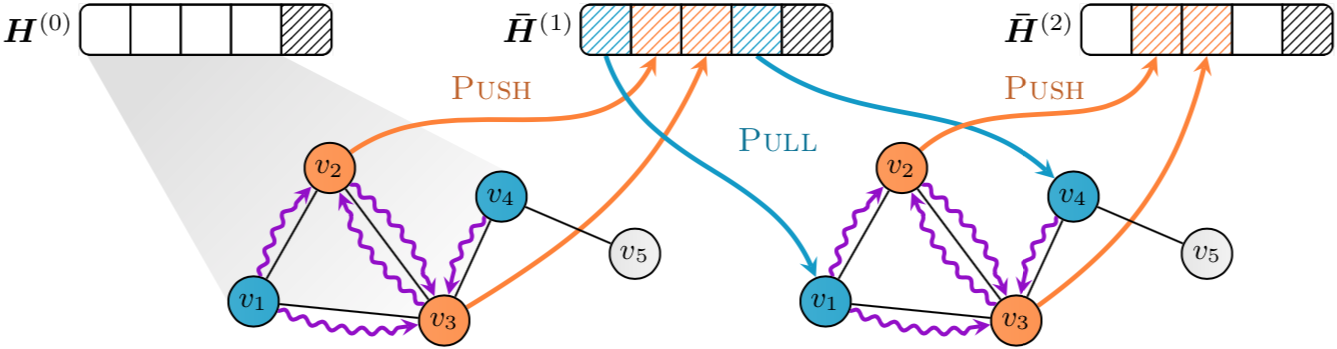
GAS prunes entire sub-trees of the computation graph by utilizing historical embeddings from prior training iterations, leading to constant GPU memory consumption in respect to input node size without dropping any data.
As a result, our approach is provably able to maintain the expressive power of the original GNN.
*PyGAS* is implemented in [PyTorch](https://pytorch.org/) and utilizes the [PyTorch Geometric](https://github.com/rusty1s/pytorch_geometric) (PyG) library.
It provides an easy-to-use interface to convert common and custom GNNs from PyG into its scalable variant:
```python
from torch_geometric.nn import SAGEConv
from torch_geometric_autoscale import ScalableGNN
from torch_geometric_autoscale import metis, permute, SubgraphLoader
class GNN(ScalableGNN):
def __init__(self, num_nodes, in_channels, hidden_channels, out_channels, num_layers):
# pool_size determines the number of pinned CPU buffers
# buffer_size determines the size of pinned CPU buffers,
# i.e. the maximum number of out-of-mini-batch nodes
super(GNN, self).__init__(num_nodes, hidden_channels, num_layers,
pool_size=2, buffer_size=5000)
self.convs = ModuleList()
self.convs.append(SAGEConv(in_channels, hidden_channels))
for _ in range(num_layers - 2):
self.convs.append(SAGEConv(hidden_channels, hidden_channels))
self.convs.append(SAGEConv(hidden_channels, out_channels))
def forward(self, x, adj_t, *args):
for conv, history in zip(self.convs[:-1], self.histories):
x = conv(x, adj_t).relu_()
x = self.push_and_pull(history, x, *args)
return self.convs[-1](x, adj_t)
perm, ptr = metis(data.adj_t, num_parts=40, log=True)
data = permute(data, perm, log=True)
loader = SubgraphLoader(data, ptr, batch_size=10, shuffle=True)
model = GNN(...)
for batch, *args in loader:
out = model(batch.x, batch.adj_t, *args)
```
## Requirements
* Install [**PyTorch >= 1.7.0**](https://pytorch.org/get-started/locally/)
* Install [**PyTorch Geometric >= 1.7.0**](https://github.com/rusty1s/pytorch_geometric#installation):
```
pip install torch-scatter -f https://pytorch-geometric.com/whl/torch-${TORCH}+${CUDA}.html
pip install torch-sparse -f https://pytorch-geometric.com/whl/torch-${TORCH}+${CUDA}.html
pip install torch-geometric
```
where `${TORCH}` should be replaced by either `1.7.0` or `1.8.0`, and `${CUDA}` should be replaced by either `cpu`, `cu92`, `cu101`, `cu102`, `cu110` or `cu111`, depending on your PyTorch installation.
## Installation
```
pip install git+https://github.com/rusty1s/pyg_autoscale.git
```
or
```
python setup.py install
```
## Project Structure
* **`torch_geometric_autoscale/`** contains the source code of *PyGAS*
* **`examples/`** contains examples to demonstrate how to apply GAS in practice
* **`small_benchmark/`** includes experiments to evaluate GAS performance on *small-scale* graphs
* **`large_benchmark/`** includes experiments to evaluate GAS performance on *large-scale* graphs
We use [**Hydra**](https://hydra.cc/) to manage hyperparameter configurations.
## Cite
Please cite [our paper]() if you use this code in your own work:
```
@inproceedings{Fey/etal/2021,
title={{GNNAutoScale}: Scalable and Expressive Graph Neural Networks via Historical Embeddings},
author={Fey, M. and Lenssen, J. E. and Weichert, F. and Leskovec, J.},
booktitle={International Conference on Machine Learning (ICML)},
year={2021},
}
```
--------------------------------------------------------------------------------
*PyGAS* is the practical realization of our *GNNAutoScale* (GAS) framework, which scales arbitrary message-passing GNNs to large graphs, as described in our paper:
Matthias Fey, Jan E. Lenssen, Frank Weichert, Jure Leskovec: **[GNNAutoScale: Scalable and Expressive Graph Neural Networks via Historical Embeddings]()** *(ICML 2021)*
GAS prunes entire sub-trees of the computation graph by utilizing historical embeddings from prior training iterations, leading to constant GPU memory consumption in respect to input node size without dropping any data.
As a result, our approach is provably able to maintain the expressive power of the original GNN.
*PyGAS* is implemented in [PyTorch](https://pytorch.org/) and utilizes the [PyTorch Geometric](https://github.com/rusty1s/pytorch_geometric) (PyG) library.
It provides an easy-to-use interface to convert common and custom GNNs from PyG into its scalable variant:
```python
from torch_geometric.nn import SAGEConv
from torch_geometric_autoscale import ScalableGNN
from torch_geometric_autoscale import metis, permute, SubgraphLoader
class GNN(ScalableGNN):
def __init__(self, num_nodes, in_channels, hidden_channels, out_channels, num_layers):
# pool_size determines the number of pinned CPU buffers
# buffer_size determines the size of pinned CPU buffers,
# i.e. the maximum number of out-of-mini-batch nodes
super(GNN, self).__init__(num_nodes, hidden_channels, num_layers,
pool_size=2, buffer_size=5000)
self.convs = ModuleList()
self.convs.append(SAGEConv(in_channels, hidden_channels))
for _ in range(num_layers - 2):
self.convs.append(SAGEConv(hidden_channels, hidden_channels))
self.convs.append(SAGEConv(hidden_channels, out_channels))
def forward(self, x, adj_t, *args):
for conv, history in zip(self.convs[:-1], self.histories):
x = conv(x, adj_t).relu_()
x = self.push_and_pull(history, x, *args)
return self.convs[-1](x, adj_t)
perm, ptr = metis(data.adj_t, num_parts=40, log=True)
data = permute(data, perm, log=True)
loader = SubgraphLoader(data, ptr, batch_size=10, shuffle=True)
model = GNN(...)
for batch, *args in loader:
out = model(batch.x, batch.adj_t, *args)
```
## Requirements
* Install [**PyTorch >= 1.7.0**](https://pytorch.org/get-started/locally/)
* Install [**PyTorch Geometric >= 1.7.0**](https://github.com/rusty1s/pytorch_geometric#installation):
```
pip install torch-scatter -f https://pytorch-geometric.com/whl/torch-${TORCH}+${CUDA}.html
pip install torch-sparse -f https://pytorch-geometric.com/whl/torch-${TORCH}+${CUDA}.html
pip install torch-geometric
```
where `${TORCH}` should be replaced by either `1.7.0` or `1.8.0`, and `${CUDA}` should be replaced by either `cpu`, `cu92`, `cu101`, `cu102`, `cu110` or `cu111`, depending on your PyTorch installation.
## Installation
```
pip install git+https://github.com/rusty1s/pyg_autoscale.git
```
or
```
python setup.py install
```
## Project Structure
* **`torch_geometric_autoscale/`** contains the source code of *PyGAS*
* **`examples/`** contains examples to demonstrate how to apply GAS in practice
* **`small_benchmark/`** includes experiments to evaluate GAS performance on *small-scale* graphs
* **`large_benchmark/`** includes experiments to evaluate GAS performance on *large-scale* graphs
We use [**Hydra**](https://hydra.cc/) to manage hyperparameter configurations.
## Cite
Please cite [our paper]() if you use this code in your own work:
```
@inproceedings{Fey/etal/2021,
title={{GNNAutoScale}: Scalable and Expressive Graph Neural Networks via Historical Embeddings},
author={Fey, M. and Lenssen, J. E. and Weichert, F. and Leskovec, J.},
booktitle={International Conference on Machine Learning (ICML)},
year={2021},
}
```